
Natural Hazards Observer
| May 2006 | Volume XXX | Number 5 |

House and White House Release Katrina Findings
In response to a tragedy such as Hurricane Katrina there are likely to be a number of reports that examine what went wrong and what went right and recommend how things can be done better next time. Two of the most anticipated of these reports were released in February:
A Failure of Initiative: The Final Report of the Select Bipartisan Committee to Investigate the Preparation for and Response to Hurricane Katrina —Following Hurricane Katrina, the U.S. House of Representatives created a committee charged with conducting a full and complete investigation and study regarding 1) the development, coordination, and execution by local, state, and federal authorities of emergency response plans and other activities in preparation for Hurricane Katrina and 2) the local, state, and federal government response to Hurricane Katrina. This document presents the committee’s findings. The full report (H. Rpt. 109-377, 569 pp., $32.00) and a supplementary report and document annex (H. Rpt. 109-396, 496 pp., $40.00) are available free online at www.access.gpo.gov/congress/house/house07cr109.html. Transcripts of the committee’s hearings are available at www.katrina.house.gov/.
 The Federal Response to Hurricane Katrina: Lessons Learned —This report from the White House is the result of a presidential order for a comprehensive review of the federal response to Hurricane Katrina. The report identifies deficiencies in the federal government’s response and lays the groundwork for transforming how the United States—from every level of government to the private sector to individual citizens and communities— handles emergency preparedness and response. Specifically, it identifies 17 lessons learned; makes 125 recommendations for policy makers and emergency managers, which have been reviewed by relevant federal departments and agencies; and includes 11 critical actions to be completed before June 1, 2006, the first day of the 2006 hurricane season. The full report (228 pp., $27.00) is available free online at www.whitehouse.gov/reports/katrina-lessons-learned.pdf.
Copies of all three documents are available in any federal depository library and can be purchased from the U.S. Government Bookstore, Superintendent of Documents, PO Box 371954, Pittsburgh, PA 15250-7954; (202) 512-1800, (866) 512-1800; http://bookstore.gpo.gov/.
Catastrophic Planning Likely Inadequate
Released in early February, the U.S. Department of Homeland Security’s (DHS) Nationwide Plan Review: Phase I Report (36 pp.) provides the status of catastrophic planning in every state and 75 of the nation’s largest urban areas.
The Phase I report to Congress, which was required by the Fiscal Year 2006 Homeland Security Appropriations Act, presents the initial findings based on the self assessments of emergency operations plans conducted by states, territories, and urban areas. It indicates that while current plans are generally consistent with existing federal planning guidance and voluntary standards, many states, territories, and urban areas are concerned about the adequacy and feasibility of their plans to deal with catastrophic events. The report is currently available at www.iaem.com/documents/Phase1Report-SubmittedtoCongress.pdf.
DHS will conduct a second phase of the Nationwide Plan Review to validate submissions and determine requirements for on-site planning assistance. The results of the peer-reviewed visits and specific recommendations to strengthen catastrophic planning are to be provided in a report to the president and Congress before June 1, 2006.
Improving FEMA’s Response Capabilities
 In February, the U.S. Department of Homeland Security (DHS) announced several new measures intended to strengthen the Federal Emergency Management Agency’s (FEMA) essential functions for more effective response to disasters. Areas specifically targeted for improvement include logistics, customer service and intake procedures, the debris removal process, and communications. The new measures are designed to improve DHS’ ability to build integrated homeland security capabilities, eliminate unnecessary bureaucracy, serve disaster victims more effectively, and empower FEMA to act with efficiency and urgency when fulfilling its response and recovery responsibilities.
To begin strengthening FEMA, DHS’ fiscal year 2007 budget request asks for increased funding—specifically, a 10 percent increase in FEMA’s budget over the budget for fiscal year 2006. The request also includes resources to upgrade FEMA’s Emergency Alert System, increase procurement staff and overall capabilities, improve capital infrastructure and information technology, and strengthen overall mitigation, response, and recovery capabilities. For more information, read the fact sheet at www.dhs.gov/dhspublic/display?content=5413.
FEMA and IAFC Launch Intrastate Mutual Aid Project
The Federal Emergency Management Agency (FEMA) and the International Association of Fire Chiefs (IAFC) are developing a National Fire Service Intrastate Mutual Aid System that will tie local fire districts and departments into statewide mutual aid networks and support implementation of the National Incident Management System (NIMS). The new system will help the fire service be better prepared to respond to large-scale or concurrent events and help bring the skills, knowledge, and tactical resources of the local fire service to the table to support NIMS and state-to-state mutual aid efforts such as the Emergency Management Assistance Compact.
The IAFC has asked the State Fire Chiefs Associations to spearhead the effort in 10 pilot states: Alabama, Georgia, Louisiana, Mississippi, Texas, Colorado, Idaho, Montana, New Mexico, and Wyoming. A team of technical experts with active fire service backgrounds and experience and success in mutual aid will support the pilot effort. The pilot states will work with fire service and emergency management stakeholders in their states in a collaborative effort to produce a formal written plan. Based on the experiences of the 10 states, the IAFC will recommend possible next steps to further enhance NIMS principles in the fire service and establish the system nationwide. For more information, contact Hyatt Simpson at hsimpson@iafc.org.
NIMS Basic: New Guides from FEMA
The Federal Emergency Management Agency (FEMA) has developed a new series of documents to help guide users through the National Incident Management System (NIMS). The “NIMS Basic” series describes the concepts and principles, systems and processes, responsibilities, and required capabilities associated with NIMS’ major components. The series consists of nine guides: NIMS Introduction and Overview, Command and Management, Preparedness, Resource Management, Communications and Information Management, Supporting Technologies, Ongoing Management and Maintenance, Incident Command System, and Resource Typing. Download copies of the guides from www.fema.gov/emergency/nims/.
New Policy Links Reconstruction Dollars to Advisory Flood Elevations
The Federal Emergency Management Agency (FEMA) is encouraging building back stronger and safer after major disasters in communities nationwide. FEMA announced in February that FEMA-funded mitigation and public infrastructure recovery projects—including those in heavily impacted areas of the Gulf Coast region—are to be tied to new, higher floodplain elevations updated by FEMA using the most accurate flood risk data available.
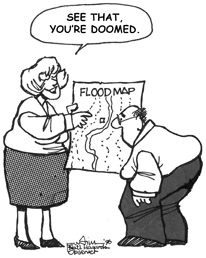
Communities recovering from disasters in Louisiana, Mississippi, and elsewhere will be required to use the new elevations when available. Called Advisory Base Flood Elevations (ABFEs), the height at which there is a 1 percent or greater chance of flooding in a given year, the rebuilding standards will be required for all FEMA-funded mitigation and public infrastructure grant-based recovery program projects. This includes the Public Assistance program, Hazard Mitigation Grant Program, Pre-Disaster Mitigation Grant program, Flood Mitigation Assistance program, and through the implementation of Executive Order 11988 Floodplain Management.
The FEMA grants tied to ABFEs are those for the repair and rebuilding of public infrastructure projects, such as schools, public safety stations, libraries, and other shared community infrastructure. Individual homeowners rebuilding with FEMA’s Individual and Households Assistance grants, while encouraged to build back to ABFEs, are not impacted by this policy. Homeowners are advised to consult their community ordinances for rebuilding guidance.
For more information, read the press releases at www.fema.gov/news/newsrelease.fema?id=23283 and www.fema.gov/news/newsrelease.fema?id=23285. Access the recovery maps and more for Louisiana and Mississippi at www.fema.gov/hazard/flood/recoverydata/.
FY 2004 and 2005 HSGP Funds Okayed for Hurricane Preparedness Exercises
This spring, the U.S. Department of Homeland Security (DHS) Preparedness Directorate’s Office of Grants and Training (G&T) is sponsoring five hurricane preparedness exercises. These exercises are designed to increase the preparedness of Eastern Seaboard and Gulf Coast states for the 2006 hurricane season that begins June 1.
G&T is updating the fiscal year (FY) 2004 and 2005 Homeland Security Grant Program (HSGP) guidance to provide the flexibility needed for full state and urban area involvement in these important and time-sensitive exercises. While FY 2006 HSGP funds can be used to support catastrophic natural disaster activities, FY 2006 funds are not currently available, and prior fiscal year HSGP grants cannot be used for natural disaster activities. This updated FY 2004 and 2005 guidance does not extend the flexibility to other activities. It only applies to hurricane preparedness exercises. As a reminder, funds from Emergency Management Performance Grants may also be used to support hurricane preparedness exercises.
To learn more, read the Office of Grants and Training Information Bulletin (No. 203, March 17, 2006) at www.ojp.usdoj.gov/odp/docs/info203.pdf. Direct questions to G&T preparedness officers or the Centralized Scheduling and Information Desk at (800) 368-6498 or askcsid@dhs.gov.
NIMS: 10-Codes and Plain English
In response to confusion over the National Incident Management System’s (NIMS) plain English requirements, the NIMS Integration Center (NIC) issued a clarifying NIMS Alert. The alert points out that 10-codes used in one jurisdiction are not the same as those used in another and stressed the importance of common terminology among responders and incident managers in an emergency situation. It is critical that all local responders, as well as those coming into an impacted area from other jurisdictions, states, and federal agencies, know and utilize commonly established operational structures, terminology, policies, and procedures.
NIMS requires that plain English be used for multiagency, multijurisdiction, and multidiscipline events, such as major disasters and exercises. Beginning in fiscal year 2007, federal preparedness grant funding is contingent on the use of plain English in major incidents requiring assistance from responders from other agencies, jurisdictions, and functional disciplines. While the NIC does not require plain English for internal operations, they strongly encourage it, emphasizing how important it is to practice terminology and procedures that will be needed in large emergencies.
Read the alert at www.fema.gov/pdf/nims/More10Codes02-08-06.pdf. Direct questions to the NIC at NIMS-Integration-Center@dhs.gov or (202) 646-3850. (A position statement from the Association of Public-Safety Communications Officials supports the requirement: www.apcointl.org/government/positions/PlainSpeechPosition021306.pdf.)
Executive Order Establishes Center for Faith-Based and Community Initiatives
On March 7, the president signed Executive Order 13397 directing the U.S. Department of Homeland Security (DHS) to establish a Center for Faith-Based and Community Initiatives. According to the order, the purpose of the center is to “coordinate agency efforts to eliminate regulatory, contracting, and other programmatic obstacles to the participation of faith-based and other community organizations in the provision of social and community services.” The new center will be part of DHS’ Preparedness Directorate. The order is in the March 9, 2006, Federal Register (Vol. 71, No. 46, pp. 12273-12276), which can be found in any federal depository library or online at www.access.gpo.gov/ and at www.whitehouse.gov/news/releases/2006/03/20060307-5.html.
Funding for Firebreaks in Hurricane-Stricken States
The U.S. Department of Agriculture (USDA) Natural Resources Conservation Service (NRCS) is making Emergency Watershed Protection program funds available so that communities in hurricane-stricken states can build firebreaks to reduce the threat of fires from downed timber, creating safer environments for residents.
A firebreak is a strip of bare land or vegetation that slows down or buffers a fire. USDA Service Centers will work very closely with state forestry departments to ensure proper procedures are being followed as they help communities and landowners construct the breaks. The NRCS will pay landowners and landusers up to 75 percent of the cost, or up to $150 per acre, to remove dead or dying timber adjacent to important community structures, such as schools and homes.
Communities or landowners interested in this assistance should contact their local USDA Service Center. Visit http://offices.sc.egov.usda.gov/locator/app?agency=nrcs for contact information. Additional information about the Emergency Watershed Protection program is available at www.nrcs.usda.gov/programs/ewp/.
Search Past Weather Data through NOAA Weather Portal
NOWData (NOAA (National Oceanic and Atmospheric Administration) Online Weather Data), a tool from the National Weather Service (NWS), provides climate information, such as past weather conditions and temperature and precipitation averages and extremes. Visitors to the NWS’ national climate Web portal at www.weather.gov/climate/ can click on a desired location on a national map and be taken directly to the local climate page of the appropriate NWS forecast office. Then, by clicking on the NOWData tab, users can access a wide range of climate products for nearly 3,900 locations. Daily weather is available for the last two years with climate averages for the standard 30-year period of 1971-2000 and extremes for as long as a station has been taking observations.
Past weather data offered by the NWS forecast offices and linked from the NOWData Web site are considered preliminary and, therefore, unofficial. Certified weather data, for uses such as litigation, are available only through the NOAA National Climatic Data Center; www.ncdc.noaa.gov/oa/ncdc.html.
Federal Earthquake Program Seeks Comments
The National Earthquake Hazards Reduction Program (NEHRP) is the federal program to reduce risks to life and property from earthquakes. The four agencies that make up NEHRP—the Federal Emergency Management Agency, the U.S. Geological Survey, the National Science Foundation, and the National Institute of Standards and Technology (NEHRP’s lead agency)—are updating the program’s strategic plan for 2006-2010. To do so, the NEHRP agencies will update Expanding and Using Knowledge to Reduce Earthquake Losses: The National Earthquake Hazards Reduction Program Strategic Plan, 2001-2005. To help with the updating process, the agencies seek public comments from the earthquake hazards reduction community on any aspect of the 2001-2005 strategic plan and how it might be improved.
Comments are due by 5:00 p.m. EDT, May 26, 2006. Access the 2001-2005 plan and the comment submittal form at www.nehrp.gov/public_comments.html. Questions about comments submittal may be addressed to info@nehrp.gov.
On April 6, the Federal Emergency Management Agency (FEMA) launched a redesign of its Web site FEMA.gov to better serve those who look to the site for timely and accurate emergency and disaster information. The new site has been restructured to make it easier for citizens, emergency personnel, businesses, and federal, state, and local government agencies to quickly find the information they need on the agency’s disaster training, preparation, mitigation, response, and recovery efforts and services.
In developing the new site, FEMA conducted a year-long usability study of their Web site and implemented recommendations from victims of disasters and those involved in disaster response and recovery efforts. FEMA will conduct ongoing usability testing of the site and analysis of Web metrics (including user research, customer comments, Web traffic reports, and the American Customer Satisfaction Index, an industry standard for measuring Web site performance over time) to continually improve the site. FEMA will listen to and work with users to ensure that the site continues to be an effective tool for disseminating information about the agency’s national and regional emergency management efforts and services.
To learn more about the redevelopment of FEMA.gov, visit www.fema.gov/media/newhomepage.shtm.
More Borrowing Authority for the NFIP
 Following two previous borrowing authority increases (see the January 2006 Observer, p. 10), yet another law has been passed to increase the amount of funds available to the National Flood Insurance Program (NFIP) to settle flood insurance claims. Public Law 109-208 temporarily increases the borrowing authority of the Federal Emergency Management Agency for carrying out the NFIP to nearly $20.8 billion through fiscal year 2008. The law can be found in any federal depository library and on the Library of Congress Web site at http://thomas.loc.gov/.
NOAA Collaborates with Australian Counterparts
The National Oceanic and Atmospheric Administration (NOAA) has signed an agreement with Australia’s Bureau of Meteorology to formalize their commitment to improving meteorological and hydrological forecasting. The five-year agreement is accompanied by an implementation strategy for Australia to adopt the digital forecast process developed by NOAA’s National Weather Service. A second component to the agreement is the enhancement of international tsunami warning systems. The technology exchange will help Australia and the United States support the Intergovernmental Oceanographic Commission’s Indian Ocean Tsunami Warning System and accelerate Australia’s capacity for planning, deploying, applying, and operationally supporting deep-ocean tsunami detection platforms, such as the U.S. Deep-Ocean Assessment and Reporting Tsunamis (DART) buoy stations. Additional cooperation will occur in the areas of warning system design and exchange of sea-level data related to these warning systems. Read the press release at www.publicaffairs.noaa.gov/releases2006/mar06/noaa06-031.html.
The National Oceanic and Atmospheric Administration has updated its storm stats for the 2005 hurricane season (see the January 2006 Observer, p. 14). The new records include 27 named storms (up from 26), 15 hurricanes (up from 13), and 4 category 5 hurricanes (up from 3 with the addition of Emily, the earliest-forming category 5 hurricane on record in the Atlantic basin and the only known hurricane of that strength to occur during the month of July). For the most recent information, view the revised fact sheet at www.noaanews.noaa.gov/stories2005/s2540.htm.

Fun Facts: Storm Names Retired
The names Dennis, Katrina, Rita, Stan, and Wilma, all players in the historic 2005 Atlantic hurricane season, were “retired” by an international hurricane committee of the World Meteorological Organization. Now retired, these five storms will not reappear on the list of potential storm names that is otherwise recycled every six years.
Retirement is saved for storms that cause particularly large losses of life and property. Retired names are not used again for sensitivity reasons and to establish distinction within the scientific and legal communities.
For 2011, Dennis, Katrina, Rita, Stan, and Wilma have been replaced with Don, Katia, Rina, Sean, and Whitney, respectively. Find out more about retired storm names at www.nhc.noaa.gov/retirednames.shtml. Names for tropical cyclones through 2010 are available at www.nhc.noaa.gov/aboutnames.shtml.
LSU Takes On Herculean Hurricane Task
Originally established in the aftermath of Hurricane Katrina as a central repository of geospatial data related to the disaster for affected areas of Louisiana, the Hurricane Katrina and Rita Information Clearinghouse has since been expanded to maintain and provide a variety of perishable data and information pertaining to Hurricanes Katrina, Rita, and Wilma. Initiated as a collaboration between Louisiana State University (LSU) and the Federal Emergency Management Agency (FEMA), the clearinghouse facilitates many of the data access and distribution needs of FEMA, state, and local efforts.
Information available on the site includes map products, reports, links, and data. Additional data that is not for public release is stored and available via secure access by authorized agencies. A research section is dedicated to providing information on research related to Katrina and Rita and the impact of these disasters on the affected people and regions. Visit the clearinghouse at www.katrina.lsu.edu/. E-mail questions about the project to clearinghouse@lsu.edu.
Mark Your Calendars
Hurricane Preparedness Week
May 21-27, 2006
www.nhc.noaa.gov/HAW2/english/intro.shtml
Lightning Safety Awareness Week
June 18-24, 2006
www.lightningsafety.noaa.gov/week.htm