
Natural Hazards Observer
| September 2006 | Volume XXXI | Number 1 |
Center Products Get Makeovers
This September, longtime readers of the Natural Hazards Observer and frequent visitors to the Natural Hazards Center’s Web site will notice some profound changes in how these products look and feel. Both of the Center’s principal avenues of information dissemination have undergone a facelift and minor reorganization.
Traditional features in the Observer such as the Invited Comment, On the Line, and most of the other major sections will remain the same, while a few resource sections will be slightly reorganized. Additionally, a splash of color and some new design elements have been incorporated to modernize the publication and make it easier to use.
A complete redesign of the Web site is expected to achieve two mutually supporting goals: improve user navigation and searchability of the site and reorganize the resources to better reflect recent changes in the hazards and disasters community. The redesign is expected to go live in late summer 2006. Watch for the upcoming transformation on a computer near you at www.colorado.edu/hazards/.
Disaster Risk Reduction Begins at School
On June 15, the United Nations International Strategy for Disaster Reduction (ISDR) and its partners launched its 2006-2007 World Disaster Reduction 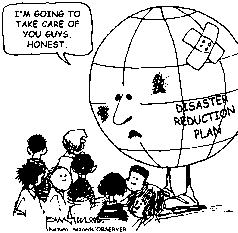 Campaign: “Disaster Risk Reduction Begins at School.” With the premise that more needs to be done to protect children from disasters, the campaign has two main objectives: promote disaster reduction education in school curricula and improve school safety. The campaign aims to inform and mobilize governments, communities, and individuals to fully integrate disaster risk reduction into school curricula in high risk countries and to build or retrofit school buildings to withstand natural hazards.
Key partners include the United Nations Educational, Scientific and Cultural Organization (UNESCO); United Nations Children’s Fund (UNICEF); ActionAid International, the International Federation of Red Cross and Red Crescent Societies; and the ISDR’s thematic cluster on knowledge and education. For more information, including a press kit, case studies, a list of events, and online resources, visit www.unisdr.org/wdrc-2006-2007/.
Closing Comments: 2006 Annual Hazards Research and Applications Workshop
Editor’s Note: The following text represents the speech given by Kathleen Tierney, director of the Natural Hazards Center, at the conclusion of the Center’s annual workshop in July 2006.
In my opening remarks, I said that this is a workshop that not only permits but actually encourages controversy, disagreement, and argument. We certainly did get what we asked for this time around. Throughout the workshop sessions, there was a sense of passion, deep concern, and deep commitment to improving the way our society and the world manage complex problems associated with hazards, disasters, and risk. Perhaps this was because 2005 was marked by so much human suffering and physical destruction both here in the U.S. and around the world. But whatever the source, passion and concern literally radiated from many of our sessions. I was not able to be in all the sessions at the same time, but I do know that vigorous discussions took place and passionate views were expressed in some sessions I did attend, including those on urban evacuation, the media and disasters, and poverty and vulnerability. I also saw throughout these last two and a half days the manifestation of a healthy skepticism toward institutions that make overblown claims and struggle mightily to put a positive spin on what is essentially a steady stream of bad news concerning how this nation approaches the challenges associated with hazards and disasters.
Controversy, argument, passion, and skepticism are positive forces. We need them now more than ever. We need members of our community to be passionate about their research and practice activities, and we need them to be outspoken with their concerns and criticisms. In the session on disasters and the media, Lee Wilkins observed that with respect to making institutions accountable, the media have lately given up their watchdog role in favor of a more comfortable and lucrative lapdog role. Katrina may have begun to reverse that dangerous trend. As with the press, so too with each and every one of us. As comfortable as it may be to sit on the fence and to stay in the ivory tower, and as comfortable as it is to say, “Let others do it,” it’s time to take a stand.
I think that as outraged and appalled as we were following the 2005 hurricane season, when Katrina devastated the Gulf Region, many of us were at least able to hope that those terrible times constituted a teachable moment. As Dennis Mileti said in the Tuesday morning plenary, “If not now, when? How many more people have to die before basic lessons about disaster loss reduction are learned and institutionalized?” Yet here we stand, nearly one year after Katrina, numerous investigations and studies later, numerous recommendations later—and where is the genuine political will to protect lives and property from future extreme events? As one Washington sage once said, “Watch what we do, not what we say.” And as we watch, what are we learning? That the nation is less safe than it was prior to the terrorist attacks of 2001, less safe than it was prior to Hurricane Katrina, and that the institutions responsible for ensuring our safety are in disarray. We face escalating threats from natural disasters as well as escalating threats from those wishing to commit willful acts of terrorism against our society; complex terrorist plots continue to succeed around the world—as we saw yesterday, tragically, in Mumbai—and in our highly mobile world, a flu pandemic may be impossible to contain. And how many people in this room believe the nation is ready to manage even one of these perils?
There are, of course, rays of hope. We learned, for example, that the president’s budget in future years will make the reduction of disaster losses a budget priority, and we heard from our panel on grand challenges for disaster reduction that there is a framework in place for implementing the grand challenges plan, both through stepped-up research efforts and through outreach and education. But again, we must watch what develops and judge those efforts accordingly.
I want to end by going back to my closing remarks from the 2005 workshop. At the end of those remarks, I said the following:
“What we as human societies have yet to understand—despite what Gilbert White has been telling us so consistently and for so long—is that nature doesn’t care. It has no memory, it feels no sense of obligation to be patient with us. It operates according to its own laws, on its own time frame. Despite our tendency to anthropomorphize natural phenomena, nature does not care! And for that reason, we must care, and we must recognize that it is we who have to comply with nature’s timetables, not the other way around…The bill has long since come due, and we will pay—not when it is convenient for us, but when nature’s timetable exacts that toll.”
Just weeks later, Katrina, Rita, and Wilma showed definitively that human societies are and always will be subject to nature’s extremes. As Dennis Mileti taught us, over time, we have designed the disasters of the future. I would add that our nation is also busy helping to fashion the deadly terrorist attacks of the future. And ladies and gentlemen, the future is now.
Workshop Materials
Each summer, hazards researchers, professionals (federal, state, and local government officials and representatives from nonprofit organizations and private industry), and other interested individuals convene for the Natural Hazards Center’s Annual Hazards Research and Applications Workshop. Participants debate, explore, and share information on a wide variety of issues. This year, sessions included discussions about recovery after Hurricane Katrina, grand challenges for disaster reduction, and the state of federal emergency management (among others).
Brief session summaries, abstracts of research presented, and descriptions of current participant projects and programs are available online at www.colorado.edu/hazards/.
2006 Mary Fran Myers Award Winner
The Gender and Disaster Network and the Natural Hazards Center are pleased to present the 2006 Mary Fran Myers Award to Maureen Fordham. Fordham, who is a senior lecturer in disaster management at the University of Northumbria in the United Kingdom, has a background in sociology of science and technology with a focus on ecology and environmental management. Her work has a special focus on women in disasters and disaster management, emphasizing their capacities and not just their vulnerabilities. Recently she has been focusing her work on children, females in particular, as active agents in disaster.
It was shortly after she began researching disasters in 1988 that she noticed a gap in the literature dealing with gender issues, especially in the context of the developed world. Since the early 90s, Fordham has been an advocate for gender and disaster research and was one of the founding members of the Gender and Disaster Network in 1997. Committed to the free exchange of knowledge and information, she has been involved with the design and management of a number of disaster-related Web sites, including the Gender and Disaster Network and Radix (Radical Interpretations of Disaster), and has served as the editor of the International Journal of Mass Emergencies and Disasters. Additionally, she is often invited to act as an advisor or participant in activities conducted by various divisions of the United Nations and other national, regional, and local governmental and nongovernmental organizations.
The Mary Fran Myers Award was established in 2002 to recognize individuals whose program-related activities, advocacy efforts, or research has had a lasting, positive impact on reducing hazards vulnerability for women and girls. Individuals whose work adds to the body of knowledge on gender and disasters, is significant for the theory and/or practice of gender and disasters, or has furthered opportunities for women to succeed in the hazards field are eligible to receive the award. Learn more about the Mary Fran Myers Award and previous award winners at www.colorado.edu/hazards/awards/myers-award.html.
Call for Quick Response Proposals
Each September, the Natural Hazards Center solicits proposals for the next round of Quick Response (QR) grants. These small grants are intended to enable social and behavioral science researchers from the United States to conduct short-term studies immediately following a disaster. Grants average between $1,000 and $3,500 and are intended to cover food, travel, and lodging expenses.
If, during the course of the next year, a disaster matching an applicant’s preapproved proposal occurs, the grant is activated and the researcher is able to immediately travel to the site. Grantees are required to submit a report of their findings to be shared with the hazards community. Reports are published by the Natural Hazards Center and are available free online.
Proposals for natural, technological, and human-induced events are considered for funding. Physical science- and engineering-based proposals are not eligible. To learn more about the program and to find out how to apply, visit www.colorado.edu/hazards/research/qr/, or request a program announcement from Greg Guibert at (303) 492-2149 or greg.guibert@colorado.edu. The deadline for proposal submission is October 20, 2006. Only complete proposals that meet all of the criteria outlined in the 2007 announcement will be considered.
The Natural Hazards Center Goes to Washington
In June, the Center partnered with the Congressional Hazards Caucus and the American Sociological Association to host a congressional seminar on critical social issues in hazards facing the United States. For a standing room only audience of Capitol Hill staffers, federal agency representatives, and others, a panel of experts spoke about pressing post-Katrina hazards issues and answered questions on a variety of topics. Following an introduction from Dennis Wenger of the Hazards Reduction and Recovery Center at Texas A&M University, Center director Kathleen Tierney discussed the social issues that arose in the storm’s response. The other featured speakers were Howard Kunreuther from the Risk Management and Decision Processes Center at the Wharton School of Business, who presented the pros and cons of comprehensive disaster insurance, and William Anderson of the National Academies of Science Natural Hazards Roundtable, who spoke about a forthcoming report by the National Research Council: Facing Hazards and Disasters: Understanding Human Dimensions.
The seminar is the latest effort by the Center to expand its educational and outreach efforts to new constituencies. Members of Congress and their staff are important partners in hazards mitigation efforts both within their own districts and for the entire nation. Through efforts such as this, the Center introduces more people to hazards and disasters research and literature and provides solid scientific information to important decision makers.
Call for Session Topics: 2007 Annual Hazards Research and Applications Workshop
The Center invites proposals for session topics for the 2007 Annual Hazards Research and Applications Workshop. Proposed topics will provide guidance to the Center as we plan and prepare the workshop’s program. Session ideas may be modified, combined, or otherwise altered by the Center and submission of a topic does not guarantee inclusion on the program. Guidelines on how to submit suggestions and the submission form are available online at www.colorado.edu/hazards/. Please submit ideas by October 20, 2006, for consideration.
Nominations Sought for UN Sasakawa Award for Disaster Reduction
The 2007 nomination process for the United Nations (UN) Sasakawa Award for Disaster Reduction is now open and seeks nominees from around the world and all sectors of society involved in issues related to disaster risk reduction. The purpose of the award is to reward individuals and institutions who contributed through innovative practices and outstanding initiatives to reducing the risk and vulnerabilities of communities to natural hazards.
The closing date for nominations is June 29, 2007. Candidates may be nominated by former Sasakawa Award laureates, representatives of institutions specializing in disaster reduction, UN specialized agencies, resident coordinators of the UN System, and permanent missions to the UN office in Geneva. To learn more about the award and the nomination process, visit www.unisdr.org/eng/sasakawa/2007/Sasakwa-Award-2007-English.pdf.
Hurricane Katrina Research Resource Web Page
The Natural Hazards Center has developed a Web page of useful resources that examine the Hurricane Katrina disaster. To limit the scope of the page and for the purposes of quality control, the resources focus on the event itself rather than what it means for the future of the hazards and disasters field and are limited to government reports, books, a few pertinent Web sites, and peer-reviewed journal articles. The page will be updated regularly and is accessible at www.colorado.edu/hazards/library/katrina.html.
Center Staffing Note
Center Staffing Notes: Julie Baxter, the Natural Hazards Center’s communications specialist, has resigned her position in order to put her planning degree to good use at AMEC Earth and Environmental. At AMEC, Julie will be working on projects in the areas of hazards mitigation and emergency management planning, floodplain map modernization, water resources, and other environmental services. Julie’s hard work on Disaster Research, the Web site, Quick Response reports, the Holistic Disaster Recovery update, and more will not be soon forgotten. She will be missed as an integral part of the Center’s staff, but we are excited that she will still be a part of the hazards and disasters community. We wish her well and look forward to working with her in the future.