
Natural Hazards Observer
| September 2006 | Volume XXXI | Number 1 |
Invited Comment
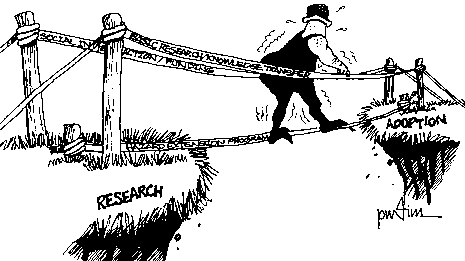
Hazards and Disasters Research:
How Would the Past 40 Years Rate?
How does one assess the significance of more than 40 years of social science research on hazards and disasters? Anyone who has recently submitted a research proposal to the National Science Foundation (NSF) knows that the proposal will be evaluated according to two criteria. The first criterion, “intellectual merit,” refers to the quality of a proposal’s theoretical foundation, research design, data collection and analysis, creativity, and scientific significance. The second criterion, “broader impacts,” refers to the positive impacts the proposed project will have on education, underrepresented groups, the field of inquiry, and, perhaps most importantly, society. This led me to wonder, what type of rating—excellent, very good, good, fair, or poor—would the past 40 years of social science research receive based on these same two criteria?
Intellectual Merit: Very Good
The field of hazards and disasters research has matured, expanded, and become more sophisticated. In 1966, the entire body of social science research could be placed on a few shelves of a modest bookcase. Today, tens of thousands of studies have been conducted.
The field has become multidisciplinary. Forty years ago, the vast majority of work was produced by geographers and sociologists. Today, these individuals have been joined by anthropologists, economists, decision scientists, psychologists, political scientists, urban and regional planners, public health researchers, and others. In the past decade, truly collaborative, interdisciplinary research, in which social scientists are working alongside engineers and physical scientists, has blossomed.
The field has shifted in the past 20 years from an initial focus on emergency preparedness and response toward one that also values and incorporates studies of mitigation and recovery. And, it has become methodologically more sophisticated, utilizing tools such as geographic information systems (GIS) to conduct social vulnerability analyses and evacuation research.
Finally, although the field has improved its theoretical base, it still lacks theoretical integration. A stronger theoretical foundation might raise the evaluation from very good to excellent.
Broader Impacts: Good/Fair
The assessment of broader impacts is less positive. Before we examine the crux of the issue, I will note some areas of positive development over time. Educational impacts have been impressive, with more than one hundred degree and certificate programs now offered at both the undergraduate and graduate levels. These efforts and the NSF Enabling Projects have brought a new generation of researchers into the field. Also, the recent evolution of social vulnerability analysis holds great potential for increasing our understanding not only of the impact of disasters on various social groups and categories, but also of the role humans play in increasing our vulnerability to natural phenomena.
Despite these advances, the impacts of hazards and disasters research on society are the essence of our problem. Specifically, I am referring to issues associated with technology transfer and the utilization of research by practitioners. Researchers can have an impact in three areas: 1) the practice of hazards and emergency management, 2) the adoption of policies by decision makers, and 3) the conceptual frame or context within which hazards and disasters mitigation, preparedness, response, and recovery issues are examined.
Once again, there have been significant improvements in the diffusion of information over the decades. The Natural Hazards Center at the University of Colorado is doing an extraordinary job of linking the national research and practitioner communities through its publications, workshops, and networks. The Earthquake Engineering Research Institute integrates social scientists into its varied activities, including the Learning from Earthquakes program, and has worked for decades to influence policy and construction practices. A number of university centers work with state emergency officials on such issues as evacuation planning. Various federal efforts, such as the Federal Emergency Management Agency’s Emergency Management Institute, Higher Education Program, and planning and mitigation guides work to educate and train professionals in science-based practice. The National Oceanic and Atmospheric Administration is working with social scientists to improve all hazards warning systems.
Indicative of these activities, improvements can be noted in such areas as warning, evacuation, emergency planning, structural and nonstructural mitigation, community recovery, and citizen training. Improved codes and construction practices have been adopted. Concepts such as an “all hazards approach” and “sustainable disaster mitigation and recovery” have become part of the thinking of policy makers and emergency managers.
However, much remains to be done. Shirley Laska’s extraordinary vulnerability assessment of the impact of a major hurricane on New Orleans is one dramatic example of sound science receiving practitioner silence. Continuing failures in emergency response resulting from inadequate planning, the downgrading of mitigation on the hazards agenda, the determined march toward command and control models of emergency management, and the reemergence of old notions of social fragility and social chaos in the emergency period are just a few indicators that the adoption and impact of 40 years of research could be stronger.
Numerous barriers continue to exist for the diffusion of social science disaster research. Among them are 1) a failure to use key windows of opportunity to keep hazards on the political agenda, 2) limited resources in research budgets for information diffusion, 3) a lack of tangible incentives for users to adopt new practices, 4) opposition by those with a vested interest in the current practices, and 5) turnover among both researchers and practitioners.
However, two important barriers deserve special attention. First, we have known for about 20 years that a social interaction model for diffusing research and innovations is far superior to alternative approaches. The pioneering studies of Robert Yin and his colleagues found that the adoption and utilization of research findings by practitioners was significantly improved when researchers and potential users seriously engaged in interaction and collaboration on all phases of the research process. This approach goes beyond having an advisory panel associated with a research project. It involves researchers and practitioners collaborating on the definition of the problem, design of the study, development of data collection instruments, analysis of the data, and generation of policy and practice recommendations.
Unfortunately, with the notable exception of Thomas Drabek and a handful of other investigators, this approach is rarely utilized within the social science research communities. Drabek has had a significant impact on the emergency management profession through his interaction with practitioners in the field and his work with them on research projects.
Furthermore, some might suggest that social scientists might benefit from closely observing earthquake engineers, who seem to have greater success with technology transfer. Engineers, building officials, and construction firms work closely together, which may facilitate the adoption of new innovations. In addition, the engineering benefits of adoption are based on what appear to be factual, “concrete” results.
However, social scientists working with emergency management officials and land use planners face a different challenge. As noted by William Anderson of the National Academies, the product of social science investigations is less likely to be concrete and more likely to be of a conceptual, organizational, or “insight” nature. The benefits that may accrue from adoption are less easy to document. Additionally, the adoption of social science findings is likely to become involved in the often rancorous political process.
The second barrier is that researchers and practitioners live in two different worlds that are incompatible with knowledge transfer. They are influenced by different cultures, reward systems, and expectations. Universities engage in outreach; however, they do not support and reward technology transfer in the social sciences as highly as theoretical knowledge generation. Within the practitioner community, often it is possible to observe the “dead hand of the past” on the throttle of organizational change. It is doubtful that significant change in these two competing cultures will occur. What is needed is a social infrastructure to link the two.
Moving Forward: Possible Linking Mechanisms
I propose three mechanisms for facilitating the adoption of research findings. First, as noted, it is critical that researchers design their research based on the social interaction model of diffusion and build adequate funds into their projects to support these efforts.
Second, there is a serious need for basic research into the process of knowledge dissemination in this field. Most of the research was done in the 1980s. Although the general topic of knowledge transfer has generated thousands of studies and competing models, research specifically focused on the transfer of knowledge regarding hazards and disasters is lacking.
Third, we need to construct a better system to span the research and practitioner communities. Although some institutions and consultants are working in this area, imagine a future in which the U.S. Department of Homeland Security adopts the U.S. Department of Agriculture’s extension program. Each county would have a Hazards and Disasters Extension Office with agents charged with transferring research results and innovations to local emergency officials. Is this scenario likely? Probably not, but steps such as these must be made to ensure that our research results get to those who can best put them to use.
Conclusion
Improving the ratings for intellectual merit and broader impacts present different challenges. Intellectual merit can be improved by strengthening the theoretical bases of future research. This task falls to the research community. Improving broader impacts must be a collaborative endeavor involving researchers and practitioners in undertaking research modeled on the social interaction framework and in developing established linking mechanisms to bridge the chasm of technology transfer. Researchers and practitioners share the common goal of lessening the toll of hazards and disasters on society. It is now time for this shared value to drive collaborative efforts.
Dennis Wenger (wenger@archone.tamu.edu)
Hazard Reduction and Recovery Center
Texas A&M University