
Natural Hazards Observer
| September 2006 | Volume XXXI | Number 1 |
Disaster Myths...First in a Series
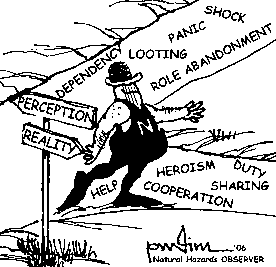
Editor’s Note: As recent events have demonstrated, the perpetuation of myths following a disaster is yet another by-product of ineffective planning, education, response, and reporting. To foster awareness and further discussion and action on the issue of disaster myths, the next six Observers will each feature an article related to disaster mythology.
The article below represents the first in the series. It serves as a general introduction to the topic, explaining what disaster myths are and the implications for the acceptance of these myths as truth. The next four articles will address specific myths: panic, dead bodies and disease, looting, and role abandonment. A concluding article will focus on how disaster myths are perpetuated and what can be done to counteract them or avoid perpetuation altogether.
Disaster Myths and Their Implications for Disaster Planning and Response
Our perception determines reality for each of us. This perception of reality then forms the basis of our determined appropriate response. If, for example, we meet and you perceive that my extended hand is a friendly gesture, you may respond by grasping my hand and moving it up and down. If you perceive that my extended hand is a threat against your person, you may decide to respond with a fist, an expletive, or turn and run away. In other words, you take action based on what you believe to be real.
What I am describing is a basic sociological tenet that forms the basis of human interaction and social structure. For approximately half a century, disaster researchers have observed a persistent disconnect between the perception of certain disaster-related events and the actual events. The perceived reality for many citizens, mass media reporters, elected officials, and public policy makers, including many emergency management workers, has been that civil disorder and disease are among the most challenging and important issues they will confront and must prepare to mitigate in every disaster.
The reality for disaster researchers differs dramatically. They stress the importance of a much different set of issues related to disaster mitigation, planning, and response. A tale of two such divergent realities leads us to two paths. The first is the one most traveled: continue to base much of disaster preparation plans and response on the perception that civil unrest and disease are the primary issues to be mitigated. The second and least traveled: move away from the disaster mythology and mitigate demonstrable problems. I argue for the road less traveled.
Disaster Mythology and the Problem with
Myth-Generated Planning
A disaster myth is a misperception that often directs the focus of government officials and responders away from the needs of victims and toward the combating of false realities. In the United States, in particular, belief in disaster mythology is very strong. The most prevalent myths are behavioral and organizational. Panic, evacuation misbehavior, disaster shock, emotional dependency, looting, price-gouging, and role abandonment are among the common perceptions of what constitutes reality in a disaster.
Often during disaster, death and injury rates are inflated, rumors of martial law spread like wildfire, and spontaneous volunteers and unwanted donations of goods flow to the scene based on the myth that anyone and anything can provide welcome relief. Another widely accepted myth is that dead bodies pose health risks for the living.
More specifically, fear of panic delays evacuation orders until evacuation is absolutely necessary, at which point a full and successful evacuation is no longer feasible. Rumors of looting hamper evacuation efforts and direct law enforcement personnel to protect property rather than save lives. Long-held beliefs about dead bodies and disease lead to mishandling of and disrespect for the dead and yet another shift in focus away from saving lives. And, unwelcome volunteers and donations result in resources that cannot be effectively managed or utilized and that often further complicate response efforts by introducing needs of their own.
Myths are perpetuated through the media, community leaders (governmental and nongovernmental), as well as through members of the general populace. The fear generated by these myths often trumps the fear of potential disaster impact realities, such as storm surge, flooding, chemical spills, and lack of electricity, food, and water. This perception leads to a very different disaster response than most researchers would recommend.
Katrina proved the power of hearsay. In the storm’s aftermath, a great deal of media attention was given to describing rapes, murders, and other wild behavior in the New Orleans Superdome. Most of these atrocities did not occur. Those that did may be directly related to the herding of people into what they believed to be a shelter and then not providing them with adequate food, water, and other necessities. Media reports of the deviant behavior affected the response by shifting the focus of the response to responder safety and ultimately slowing the flow of help that was so desperately needed.
When myths are accepted as truth, precious time and resources are misdirected, populations become problems when they can really be assets, and the real problems of mitigation, planning, and response go unrecognized. Even when a myth is not accepted as truth, emergency workers may often hesitate to publicly refute it for fear of looking foolish or further hindering appropriate protective behavior. A city manager once told me that he knows looting is rare in a disaster. Nevertheless, to encourage his citizens to evacuate, he has to convince them that looting will be prevented.
Another challenge to myth busting is that when one myth becomes reality, e.g., looting in Hurricane Katrina, the perception is reinforced as a problem to be reckoned with in every disaster. Implications for this type of reaction are policies that reinforce the dangers mentioned above (e.g., militarization of disaster response). Ultimately, myth perpetuation means that unnecessary damage, injuries, and loss of life may be incurred.
Observations versus Perceptions
The perception that disasters automatically result in human depravity and disease is not supported by the evidence. Do some of the myths ever become reality? Yes. However, there are more important mitigation, planning, and response issues encountered in any disaster. Looting did occur in Katrina. While it was portrayed as deviant, much of it was found to be for food and water and other life supporting materials. A better organizational response would have eliminated the suffering that led to this behavior and its characterization. Also, thefts occur everyday and everywhere in nondisaster time. Perspective is needed. Life is more important than property.
In disaster time, the community of human beings does not normally break down. In sharp contrast with the image commonly perceived, survivors are not apathetic or panic-stricken. Looting behavior and price-gouging are exceedingly rare. Also, police and fire personnel usually stay on the job, putting the needs of victims and the duty they have sworn to uphold before their own personal needs, concerns, and safety.
In reality, an emergent norm process occurs that results in the adoption of those behavioral guides that subscribe to the belief, or value, that humans in trouble must be helped. Survivors share their tools, food, equipment, and, especially, their time. Groups of survivors tend to emerge to respond to each others’ needs. They search for the injured and the dead, they provide support, and they begin clean-up activities. We need to incorporate the survivors, the would-be victims, as resources who participate in the response before and after impact: they are part of the solution, not the problem. Treating the public as the problem only makes things worse.
Conclusion
So we find that reality and popular perception usually diverge—so what? Emergency personnel, elected officials, the mass media, and citizens tend to plan for and respond to those events they anticipate encountering before, during, and after a disaster. If, as is commonly found, they plan to respond to myth, they will not be prepared to respond to reality. If we plan to focus on controlling deviant behavior, we are unprepared to effect a successful evacuation. Time, energy, and resources are then misdirected away from a focus on the timely transport of potable water, food, medical personnel, and other necessities. The result? Unnecessary suffering will likely be added to that already experienced by the victims and the responders.
Final Observation
If you perceive that I know what I am talking about on the subject at hand, you will probably embrace the message and seek to spread the word accordingly. On the other hand, if you perceive that I am yet another in a long line of eggheads who are detached from real world experience, then you are likely to ignore the word and reinforce what I claim to be myth. Doubters should ask themselves, how did the response to Hurricane Katrina work for us?
Henry W. Fischer III (Hank.Fischer@millersville.edu)
Center for Disaster Research & Education
Millersville University of Pennsylvania
Learn More
If you would like more information about disaster myths and behavioral and organizational mitigation, planning, and recovery challenges, search HazLit, the Natural Hazards Center’s online library database, at www.colorado.edu/hazards/library/. Recommended authors to search include, but are not limited to, Claude de Ville de Goyet, Erik Auf der Heide, Thomas E. Drabek, Russell R. Dynes, Henry W. Fischer III, Dennis S. Mileti, David M. Neal, Brenda D. Phillips, E.L. Quarantelli, Kathleen J. Tierney, Tricia Wactendorf, and Dennis E. Wenger.