
Natural Hazards Observer
| September 2006 | Volume XXXI | Number 1 |

Prepare for Recovery Now:
Lessons from Katrina
In addition to the tragic loss of life, Hurricane Katrina will have staggering long-term economic, environmental, and social impacts on the Gulf Coast and surrounding communities. Already, these consequences are emerging, including a dissolution of the tax base, conflicts over the reconstruction of housing and cultural landmarks, and strained racial and socioeconomic relations.
The effects of this disaster have clearly demonstrated that mitigation and preparedness are vitally important for disaster recovery. As other disasters have done in the past, Katrina confirmed that practical investments in risk reduction, mitigation, and emergency planning are important tools for reducing the enormous burden disasters place on individuals, business owners, and all levels of government.
In the immediate aftermath of Katrina, I traveled to Louisiana, at the request of the governor, to assist with the state’s response and recovery operations. The severity and magnitude of the storm and the formidable recovery process ahead are indisputable. I am impressed with the dedication and commitment shown in the past year by state and local officials in meeting citizens’ immediate needs as well as in improving the emergency management system.
Before Katrina, very few states had programs in place that planned for long-term community recovery. This meant that after a disaster, important decisions with lasting effects were made with good intentions, but on an ad hoc basis. Unused trailers, expensive blue tarp contracts, and abandoned school buses serve as illustrations of the need for improved planning before an event. The experience of Louisiana communities has taught jurisdictions everywhere that the scope of emergency plans and exercises must be expanded to include a comprehensive system of preparedness, response, recovery, and mitigation for catastrophic disasters.
Hurricane Katrina revealed to Americans the vulnerabilities facing many of our largest and most vibrant communities. Perhaps most importantly, this revelation stimulated a national effort to mitigate damage from future disasters and prepare for events of similar magnitude. Already, cities and states across the country have begun to improve their preparedness efforts. As a result of Katrina, Philadelphia conducted a review of its planning and resources, New York City enhanced its hurricane plan so it will be more self-sufficient in a disaster, and California’s Little Hoover Commission released a report on preparing the state for a catastrophic event. Now, one year after the devastating storm, we must consider what steps the nation must take to protect communities from a similar misfortune.
Discussion
Surge Capacity Planning —Effective disaster preparedness relies on the ability to anticipate the needs of displaced communities following a disaster. As we saw in Louisiana, a lack of planning for the mass care and sheltering of people and animals intensifies the impact caused by a disaster and creates new issues. Plans to shelter thousands of refugees in New Orleans’ Superdome were inadequate, and, consequently, conditions there deteriorated quickly. In a mass casualty or catastrophic event in any city, we must seriously consider how to manage large numbers of displaced and injured people who will need medical care, shelter, and other assistance once evacuated.
As such, surge capacity plans should involve hospitals, schools, and other community organizations, especially when an emergency plan relies on the use of their facilities and equipment. Contingency plans should address what to do in the event a facility is not available, as was the case with Charity Hospital in New Orleans. Surge capacity plans should also be established for mutual aid: to shelter and care for victims from neighboring communities.
Mutual aid agreements, such as the Emergency Management Assistance Compact (EMAC), allow assets and resources to be shared between jurisdictions. During Hurricane Katrina, jurisdictions across the nation contributed invaluable assistance through EMAC by providing a variety of resources, including U.S. National Guard troops, engineering support, and meals and water. EMAC is an invaluable tool for meeting immediate disaster response needs that extend beyond local resources.
Developing Capability for Interoperable Communications — Following the storm, utility lines were down and government officials sent “runners” to deliver communications.
Cell phone signals, if available, were weak. St. Bernard Parish, Louisiana, had one functioning radio. Katrina reiterated one of the chief lessons of 9/11: interoperable and reliable communications equipment is vitally important. In the short term, emergency personnel need inexpensive workaround technology that fosters interoperability in the field. In the long term, Congress must pass national standards to ensure that responders and other critical workers can communicate. Communications are the foundation for public safety, and we will not have an effective response and recovery until these needs are addressed.
Creating Public Private Partnerships —Katrina demonstrated that after a catastrophic event, the federal government’s response to the local community’s needs will likely be delayed. States, local communities, businesses, and citizens need to plan to be self-reliant. Before disaster strikes, local employers, their employees, and emergency managers should discuss emergency preparedness and planning priorities. Cities and states need to know what resources businesses can contribute in a crisis and what businesses will require from them to maintain critical operations.
The private sector can make its resources available through standby contracts with governments to provide critical postdisaster services (e.g., debris removal, water, ice, response coordination). Such contracts allow states and local governments the flexibility to negotiate on costs and to select the most qualified providers. Immediately following Katrina, the federal government worked to secure mobile home manufacturers with 24-hour bid deadlines that companies struggled to meet and that prohibited the cost-competitiveness afforded by standby contracts. In the event of a disaster, effective response will rely on the coordination and cooperation of all available assets—both public and private.
Incorporating Hazards Mitigation and Building Codes —To date, many postdisaster activities designed to improve disaster management have focused on strengthening weather predictions and providing postevent relief. However, risk mitigation is more than warnings and relief. Hazards mitigation protects communities’ critical infrastructure, reduces exposure to liability, and minimizes disruptions to lives and businesses. When compared with the cost of responding to and recovering from an unmitigated disaster, successful mitigation requires a significantly reduced financial investment.
Gulf Coast communities have an excellent opportunity to incorporate mitigation techniques into their rebuilding efforts. Louisiana’s governor recognized this and called for a special session of the Louisiana State Legislature to adopt statewide building codes. Instituting, strengthening, and enforcing building codes, e.g., discouraging new housing developments in risk-prone areas, are some of the most effective ways to minimize disaster impacts. Louisiana emergency management personnel are working to ensure that rebuilding efforts increase structural stability to better withstand future hurricanes. Those communities that take steps to reduce their risks will realize significant returns on their investments.
Ensuring for Continuity of Government —States and local governments were crippled by Hurricanes Katrina and Rita and, in many cases, unable to designate lines of succession and sustain orderly continuation of critical government functions. In Cameron Parish, Louisiana, Rita devastated the countryside. Immediately after the storm, the parish’s director of the Office of Emergency Preparedness resigned. Because the parish did not have a plan to designate a successor or share resources with other jurisdictions, the local government was quickly overwhelmed.
Katrina reemphasized that emergency preparedness is not solely for first responders—it requires the cooperation and integration of all levels of government and calls for the institutionalization of continuity of government plans in all state and local agencies, divisions, and departments. From the governor’s cabinet to social services, every entity must review, update, and practice its emergency operations plans. Departmental and executive leadership should promote and participate in the planning and training process.
Updating the Stafford Act —The Robert T. Stafford Disaster Relief and Emergency Assistance Act (Stafford Act) was designed by Congress to bring an orderly and systematic means of federal disaster assistance to state and local governments. However, Hurricane Katrina proved that the act does not adequately provide for disasters of such catastrophic proportions.
The Stafford Act sets the federal share for the Public Assistance Program at no less than 75 percent and no more than 90 percent (with possible exceptions) of eligible costs of a disaster. After 9/11, the Federal Emergency Management Agency, at the request of the president, adjusted the federal/state cost share to allow for 100 percent reimbursement to New York for all categories of Public Assistance. Currently, for Katrina, the federal government is reimbursing Louisiana 100 percent for debris removal and emergency protective measures and 90 percent for all other Public Assistance categories.
Congress should enact legislation that allows for an automatic upward adjustment of the federal cost share of all Public Assistance from 75 to 100 percent in the event of a catastrophe. They should also amend the Stafford Act to allow for a 100 percent federal cost share for other critical needs, such as medical, dental, funeral, transportation, and personal property expenses, in the event of an extensive disaster.
In addition, the cap for Community Disaster Loans funding, which is currently limited to 25 percent of a local community’s annual operating budget with a $5,000,000 ceiling (which was lifted by the Community Disaster Loan Act of 2005 in regard to Katrina), should be eliminated in the event the devastation incapacitates the delivery of essential services or continuity of government in impacted communities.
While the establishment of specific funding guidelines and regulations are important, officials must have the flexibility to use common sense and sound judgment in the allocation of funding during the recovery process. The bottom line is that the federal government should work with states and victims to enhance the recovery process and relieve the financial burden following events such as Hurricane Katrina.
Educating and Communicating with Citizens —The public must be educated about mitigation, evacuation, and preparedness to avoid the types of loss and human suffering that occurred along the Gulf Coast. They rely on authorities to help them understand the proper course of action before, during, and after a crisis event. More must be done at all levels of government to ensure that individual community members learn how to prepare themselves and their loved ones for disasters. Numerous local jurisdictions, such as San Francisco, New York, and the National Capital Region, have taken advantage of National Preparedness Month (September) to launch disaster preparedness public awareness campaigns. Governments that have not implemented awareness campaigns should consider following these examples.
Coordinating Long-Term Recovery —A central coordinating body is needed in the wake of catastrophic events to oversee disaster recovery policy and establish priorities for funding. In Louisiana, the Louisiana Recovery Authority (LRA) was established by an executive order of the governor and has proven invaluable to the state’s ability
to address crosscutting policy and recovery issues. Individual state agencies are often overwhelmed by having to deal with both disaster and daily missions, and an entity like the LRA builds consensus and provides the necessary focus needed to approach disaster situations.
Conclusion
In the aftermath of the devastating 2005 hurricane season, all levels of government and the private sector have an incredible opportunity to learn from this and other past experiences to enhance disaster response and long-term recovery practices. Undoubtedly, a renewed focus on mitigation and comprehensive planning will improve future actions and reduce the impact on our vulnerable communities.
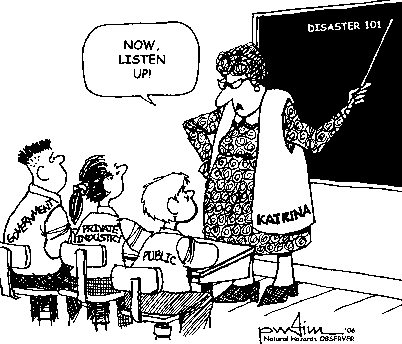
National preparedness requires the coordination of the public, private industry, and all levels of government. By gaining the support and efforts of local community leaders and businesses, we can be assured a more coordinated and efficient disaster response. As we continue to plan and organize our efforts, recognizing opportunities for improvement, we will be better prepared as a nation for the next disaster event.
James Lee Witt (info@wittassociates.com)
James Lee Witt Associates