
Natural Hazards Observer
| September 2006 | Volume XXXI | Number 1 |

September Is National Preparedness Month
September 2006 marks the third annual National Preparedness Month, the nationwide effort to encourage Americans to prepare for emergencies in their homes, businesses, and schools. Throughout the month, the U.S. Department of Homeland Security will work with a wide variety of organizations, including local, state, and federal government agencies and the private sector, to highlight the importance of family emergency preparedness and promote individual involvement through events and activities across the nation.
These organizations will provide information, host events, and sponsor activities that disseminate emergency preparedness messages to, and encourage action in, their customers, members, employees, stakeholders, and communities across the country. Specifically, these activities will urge Americans to get emergency kits, make emergency plans, educate themselves about the threats to their communities, and get involved with their communities’ preparedness efforts.
For more information about National Preparedness Month, including a calendar of events, visit www.ready.gov/america/npm/.
Executive Order: Public Alert and Warning System
In an Executive Order issued in late June, the president called for a strengthening of the nation’s public alert and warning system to ensure that under all conditions the president can communicate with the American people. Specifically, the order charges the secretary of the U.S. Department of Homeland Security (DHS) with implementing an effective, reliable, integrated, flexible, and comprehensive system to alert and warn the American people in situations of war, terrorist attack, natural disaster, or other hazards to public safety and well-being. This includes inventorying and evaluating current systems; establishing or adopting common alerting and warning protocols, standards, terminology, and operating procedures; ensuring the capability to adapt the distribution and content of communications; including the capability to alert and warn all Americans, including those with disabilities and non-English speakers; requ iring training, tests, and exercises as well as public education efforts; working with the private sector and governmental authorities, including emergency response providers; and administering the Emergency Alert System (EAS). Heads of other departments and agencies are instructed to provide assistance and information to the secretary of DHS as pertains to the implementation of the order.
The secretary of DHS is required to submit to the president a plan for the implementation of this order, together with any recommendations he finds appropriate, by the end of September 2006. Executive Order 13407 is in the June 26, 2006, Federal Register, Vol. 71, No. 124, pp. 36975-36977, which can be found in any federal depository library and online at www.gpoaccess.gov/fr/, and at www.whitehouse.gov/news/releases/2006/06/20060626.html.
DHS Weighs In on Catastrophe Plans
The U.S. Department of Homeland Security (DHS) has issued results from its national assessment of the country’s catastrophic planning capabilities. Responding to directives from the president and Congress following Hurricane Katrina, the Nationwide Plan Review: Phase 2 Report (174 pp.) examines whether existing emergency operations plans for states and urban areas are sufficient for managing a catastrophic event and presents conclusions on actions needed for improvement. These findings and conclusions will be addressed by a new National Preparedness Task Force.
Conducted in all 56 states and territories and 75 urban areas over six months, the review is the most comprehensive assessment of emergency operations plans to date relative to planning for a catastrophic event. The two-phase review began with self-assessments of key planning components (see the May 2006 Observer, p. 5) followed by peer reviews conducted by teams of former state and local homeland security and emergency management officials. Assessed as sufficient, partially sufficient, or not sufficient to manage a catastrophic event, the majority of components fell into the partially sufficient category.
While the review found that most areas of the country are prepared to handle standard disaster situations, all levels of government need to improve emergency operations plans for catastrophic events such as a major terrorist attack or category 5 hurricane. Several areas, including evacuation, attention to populations with special needs, command structure, and resource management, were noted as needing significant attention.
Download a copy of the report at www.dhs.gov/xlibrary/assets/Prep_NationwidePlanReview.pdf. The press release and two fact sheets, “ Nationwide Plan Review” and “Nationwide Plan Review Initial Conclusions,” are available at www.dhs.gov/xnews/archives/2006_junearch.shtm.
NOAA Continues to Predict Above-Normal Hurricane Season
The peak of the 2006 Atlantic hurricane season has arrived and the National Oceanic and Atmospheric Administration (NOAA) is reiterating its prediction for an above-normal number of storms. Despite the slow start, NOAA’s experts have projected a total of 12 to 15 named storms for the entire season, including 7 to 9 hurricanes, 3 to 4 of which may become major hurricanes (category 3 or higher). This forecast is slightly lower than the outlook issued in May (see the July 2006 Observer, p. 7), but remains above the seasonal average of 11 named storms, 6 hurricanes, and 2 major hurricanes. For the complete August update to the hurricane outlook, visit the National Weather Service Climate Prediction Center Web site at www.cpc.ncep.noaa.gov/products/outlooks/hurricane.shtml.
DHS Completes National Infrastructure Protection Plan
In June, the U.S. Department of Homeland Security (DHS) released the National Infrastructure Protection Plan (NIPP), a comprehensive risk management framework that clearly defines critical infrastructure protection roles and responsibilities for all levels of government, private industry, nongovernmental organizations, and tribal partners. The NIPP builds on the principles of the National Strategy for Homeland Security and its companion strategies for the physical protection of critical infrastructure and key assets and the securing of cyberspace. It also fulfills requirements in Homeland Security Presidential Directive 7 (HSPD-7) and the Homeland Security Act of 2002.
HSPD-7 identified 17 critical infrastructure and key resource sectors that require protection from a terrorist attack or other hazard event. Those sectors are agriculture and food; energy; public health and health care; banking and finance; drinking water and water treatment systems; information technology; telecommunications; postal and shipping; transportation systems, including mass transit, aviation, maritime, ground or surface, and rail and pipeline systems; chemical; commercial facilities; government facilities; emergency services; dams; nuclear reactors, materials, and waste; the defense industrial base; and national monuments and icons. Sector-specific plans that complement the NIPP and detail the risk management framework are in the works.
For more information about the plan or to get a copy (196 pp.), visit www.dhs.gov/xprevprot/programs/editorial_0827.shtm or e-mail NIPP@dhs.gov.
EPA Wants Americans to Beat the Heat
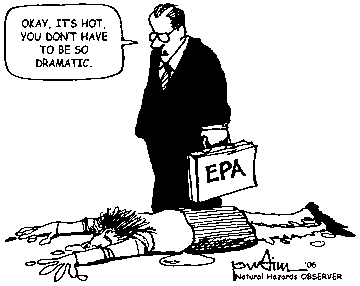 Excessive Heat Events Guidebook (60 pp.), released in June from the U.S. Environmental Protection Agency (EPA), is designed to help community officials, emergency managers, meteorologists, and others plan for and respond to excessive heat events. Developed with the National Oceanic and Atmospheric Administration, the Centers for Disease Control and Prevention, and the U.S. Department of Homeland Security, it highlights best practices that have been employed to save lives during excessive heat events in different urban areas and provides a menu of options that officials can use to respond to these events in their communities.
Download a copy at http://epa.gov/heatisland/about/heatguidebook.html. To request a free printed copy, call the National Service Center for Environmental Publications at (800) 490-9198. A two-page “guidebook in brief” offers summary information and useful tips for both the public and public officials that can be used when preparing for and responding to excessive heat and is available at http://epa.gov/heatisland/about/pdf/EHEguide-brief_final.pdf. Additional information from the EPA about extreme heat can be found at www.epa.gov/naturalevents/extremeheat.html.
NIST Reports on Performance of Structures in Hurricanes Katrina and Rita
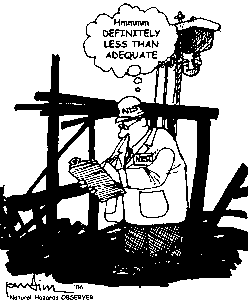 A recent report from the National Institute of Standards and Technology (NIST) documents the findings of a multiorganizational team—coordinated by NIST and made up of experts from private-sector, academic, and federal entities—that deployed technical experts to areas impacted by Hurricanes Katrina and Rita to conduct a reconnaissance on the performance of a variety of physical structures during the storms. The reconnaissance was intended to identify new technical issues that need to be addressed in the rebuilding effort, in the improvement of building standards and model codes, and in future research studies and to build on knowledge gained from previous post-hurricane damage assessments. It found that stricter adherence to existing building standards, model building codes, and good building practices (and a greater recognition of the risks posed by storm surge) could minimize the kind of structural damage experienced in the Gulf Coast states last year.
Performance of Physical Structures in Hurricane Katrina and Hurricane Rita: A Reconnaissance Report (270 pp.) makes 23 recommendations for specific improvements in the way that buildings, physical infrastructure (such as bridges and utilities), and residential structures are designed, constructed, maintained, and operated in hurricane-prone regions. The recommendations make clear what actions can be taken immediately to lessen or prevent hurricane damage to structures and defines actions that will require more time and effort.
Find out more about the reconnaissance and access the report at www.nist.gov/public_affairs/releases/hurricane _report060906.htm.
FEMA Issues Two New Recovery Strategies
To improve the quality, speed, and accountability of federal disaster support to state and local partners, the Federal Emergency Management Agency (FEMA) has issued recovery strategies for mass-sheltering and housing assistance and debris removal operations. These new strategies reflect important lessons learned from Hurricane Katrina and outline a framework for guiding federal and state operational responses to presidentially declared emergencies and disasters.
The mass-sheltering and housing assistance strategy includes a protocol to dispatch field registration personnel and mobile registration intake centers to shelters to proactively seek out and register evacuees for FEMA assistance. It also addresses temporary housing in states outside the disaster area, evacuee return transportation options, transitional sheltering, and changes to how certain forms of financial assistance may be implemented and expedited. Access the strategy at www.fema.gov/pdf/media/2006/rs-2006-1.pdf.
The debris removal operations strategy summarizes key actions of the federal government and defines eligible private and public debris as it pertains to reimbursable removal; describes the circumstances under which the federal government will initially manage debris removal operations; reflects recent changes to equalize cost-share application; and establishes the roles, responsibilities, and expectations of federal, state, and local governments. A key component of the this strategy is the Debris Removal Contractor Registry (https://ci.hsin.gov/usp3_nerr/default.aspx), a nationwide registry that allows debris removal companies to list their capabilities and availability to help emergency managers establish debris removal contracts and agreements in advance of a disaster. Access the strategy at www.fema.gov/pdf/media/2006/rs-2006-2.pdf.
FEMA Addresses Reports of Fraud
In June, the Government Accountability Office (GAO) presented testimony to the U.S. House of Representatives Committee on Homeland Security Subcommittee on Investigations that approximately $1 billion in disaster relief payments made by the Federal Emergency Management Agency (FEMA) following Hurricanes Katrina and Rita through February 2006 were improper and potentially fraudulent. The testimony focused on payments to registrants who used invalid information to apply for disaster assistance and did not address other types of impropriety or potential fraud, such as insurance fraud and false damage claims.
In response, FEMA released a statement that acknowledged the problem and indicated that the agency has been aggressively overhauling its processes to eliminate processing errors and fraudulent abuse. New, more stringent controls and safeguards are in place for the 2006 hurricane season, including an upgraded Internet registration system that rejects duplicate registrations and identity proofing software that subjects all Individual and Households Program registrations to the same criteria (including verification of Social Security numbers).
A fact sheet, “Improving Safeguards in the Delivery of FEMA Assistance Programs,” is available at www.fema.gov/pdf/media/2006/safeguards_fact_sheet.pdf, and a statement by FEMA’s acting deputy director of recovery to the U.S. House of Representatives Committee on Homeland Security Subcommittee on Investigations can be accessed at www.fema.gov/pdf/media/2006/dannels_statement.pdf. To learn more about the findings of the GAO, read the report, Hurricanes Katrina and Rita Disaster Relief: Improper and Individual Assistance Estimated to $1.4 Billion (33 pp.), at www.gao.gov/new.items/d06844t.pdf.
Interim Rule Expands Boundaries for Sheltering and Evacuation Assistance
Hurricanes Katrina and Rita created a significant need for evacuation and sheltering outside of the counties and states that were initially designated eligible for assistance under presidential emergency or major disaster declarations. At the time, the federal government did not have a mechanism to provide assistance to those entities that provided evacuation and sheltering services outside the designated areas. As a result, the Federal Emergency Management Agency (FEMA) issued an interim rule that allows for reimbursement of sheltering and evacuation costs incurred outside of areas designated under presidential emergency or major disaster declarations if the costs are otherwise eligible for Public Assistance funding.
Effective July 14, 2006, the interim rule can be found in the July 14, 2006, Federal Register, Vol. 71, No. 135, pp. 40025-40027, which is available in any federal depository library and online at www.gpoaccess.gov/fr/. For more information, contact James A. Walke, FEMA; (202) 646-2751; james.walke@dhs.gov.
FTA Requests Comments on Emergency Procedures for Public Transportation Systems
The Federal Transit Administration (FTA) has issued a notice of proposed rulemaking to establish procedures for granting relief from federal transit administrative requirements (the FTA does not have the authority to waive statutory requirements) in times of emergencies. In the aftermath of Hurricanes Katrina and Rita, the FTA received numerous requests for relief from these requirements. The process to address requests was time consuming and delayed responses. The FTA now seeks to create a process to quickly and efficiently handle requests for relief by establishing an emergency relief docket within two business days of an emergency or disaster declaration that affects transit agencies.
To find out more about the proposed rulemaking and how to make comments, read the notice in the August 8, 2006, Federal Register, Vol. 71, No. 152, pp. 44957-44960, which is available in any federal depository library and online at www.gpoaccess.gov/fr/, and at www.fta.dot.gov/. Comments are due by October 10, 2006. For more information, contact Bonnie L. Graves, Legislation and Regulations Division, Office of Chief Counsel, FTA; (202) 366-4011; Bonnie.Graves@dot.gov.
NOAA Launches Online All Hazards Monitor
NOAAWatch, a Web site from the National Oceanic and Atmospheric Administration (NOAA), is a Web portal offering information about ongoing environmental events and explains NOAA’s role in prediction, monitoring, and recovery. It integrates NOAA data, products, observations, satellite images, and more to provide public access to current information on a number of environmental threats, such as oil spills, hurricanes, tsunamis, and space weather, all on one site. Permanent features include the present weather outlook and warnings, satellite image of the day, and educational pages. NOAAWatch went live on June 1, the first day of the 2006 hurricane season. Visit the new site at www.noaawatch.gov/.
FCC Report Reviews Katrina’s Impact on Communications
In June, the Federal Communications Commission (FCC) released the report Independent Panel Reviewing the Impact of Hurricane Katrina on Communications Networks: Report and Recommendations to the Federal Communications Commission (53 pp.). The report is a study of the storm’s impact on the telecommunications and media infrastructure in the affected areas and offers recommendations for improving disaster preparedness, network reliability, and communications among first responders.
The panel found three main problems that caused the majority of communications network interruptions: flooding; lack of power and/or fuel; and failure of redundant pathways for communications traffic. Significant impediments to the recovery effort were also noted.
Based on its observations, the panel made recommendations in four basic areas: Prepositioning the communications industry and the government to achieve greater network reliability and resiliency, improving recovery coordination to address existing shortcomings and to maximize the use of existing resources, improving the operability and interoperability of public safety and 911 communications in times of crisis, and improving communication of emergency information to the public.
Read the report at www.fcc.gov/eb/hkip/karrp.pdf.
National Incident Management Systems (NIMS) Public Information Systems, IS-702, is a new independent study course offered by the Federal Emergency Management Agency (FEMA). The public information systems described in NIMS are designed to effectively manage public information at an incident, regardless of the size and complexity of the situation or the number of entities involved in the response. The goal of this course is to facilitate NIMS compliance by providing local and state public information officers (PIOs) with the basic information and tools they need to apply the NIMS public information systems and protocols during incident management. Find out more and take the class at www.training.fema.gov/EMIWeb/IS/IS702.asp.