February 24, 2026, 1:00 p.m. to 2:00 p.m. MDT / February 25, 2026, 9:00 a.m. to 10:00 a.m. NZT
The Christchurch Earthquake Sequence at 15
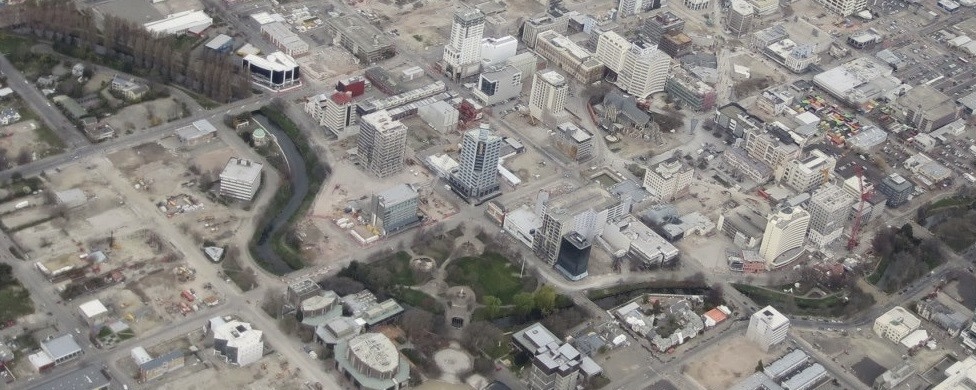 An aerial image taken in 2012 or 2013 showing the many empty lots where buildings have been demolished.
Webinar Description
On February 22, 2011, a magnitude 6.3 earthquake rocked New Zealand’s Canterbury Region, claiming 185 lives, injuring thousands, and damaging hundreds of buildings in Christchurch beyond repair. The disaster deeply affected tens of thousands of people living in the nation's second-largest city. Infrastructure—roads, bridges, water systems—was badly disrupted, and some neighborhoods were deemed completely uninhabitable for years afterwards.
The Christchurch Earthquake was a turning point disaster in New Zealand’s history, prompting major changes in how cities across the nation and globally prepare for and respond to disasters. It also spurred new ideas for urban renewal and resilience in hazard-prone terrain.
This webinar will bring together disaster and resilience experts from across New Zealand to mark the 15th anniversary of this deadly catastrophe. Panelists will reflect on how response to this earthquake, and the prolonged recovery that followed, profoundly influenced disaster research, practice, and policy. They'll also discuss lessons from Christchurch that have been overlooked and opportunities to strengthen earthquake and disaster resilience in the future.
Speakers:
Sarah Beaven, University of Canterbury
Julia Becker, Massey University
Ken Elwood, University of Aukland
Tom Wilson, University of Canterbury
Natural Hazards Center Overview Slides
Transcript
Chat History

Sarah Beaven is a senior lecturer in Disaster Risk and Resilience at the University of Canterbury|Te Whare Wānanga o Waitaha, and co-director of the Disaster Risk and Resilience programme in the School of Earth and Environment. Her research is concerned with disaster risk governance and decision-making over time, and the theory and practice of managing the effects of institutional misalignments on interdisciplinary and cross-sector collaborations.

Ken Elwood serves as the Chief Engineer (Building Resilience) for New Zealand's Ministry for Business Innovation and Employment and the Natural Hazards Commission. He is also a professor of earthquake engineering at the University of Aukland|Waipapa Taumata Rau, where his research interests include seismic assessment of existing concrete and masonry buildings, post-earthquake recovery, and earthquake disaster resilience. He was in Christchurch during the February 2011 Christchurch earthquake and served as co-lead for the Earthquake Engineering Research Institute's Learning from Earthquake mission for the event.

Julia Becker is a professor at the Joint Centre for Disaster Research in the School of Psychology at Massey University, where she conducts social science research on a range natural hazard and environmental issues. She specialises in researching individual and community preparedness, community resilience, land-use planning for natural hazards, and hazard-event warnings. She has worked extensively in Canterbury before and during the Canterbury (Christchurch) Earthquake Sequence, and following the Kaikōura earthquake.

Tom Wilson is the Chief Science Advisor for the New Zealand National Emergency Management Agency|Te Rākau Whakamarumaru (NEMA). He is also a professor of Disaster Risk & Resilience at the University of Canterbury|Te Whare Wānanga o Waitaha.