August 18, 2026, 11:00 a.m. to 12:00 p.m. MDT
50 Years Since the Big Thompson Flood
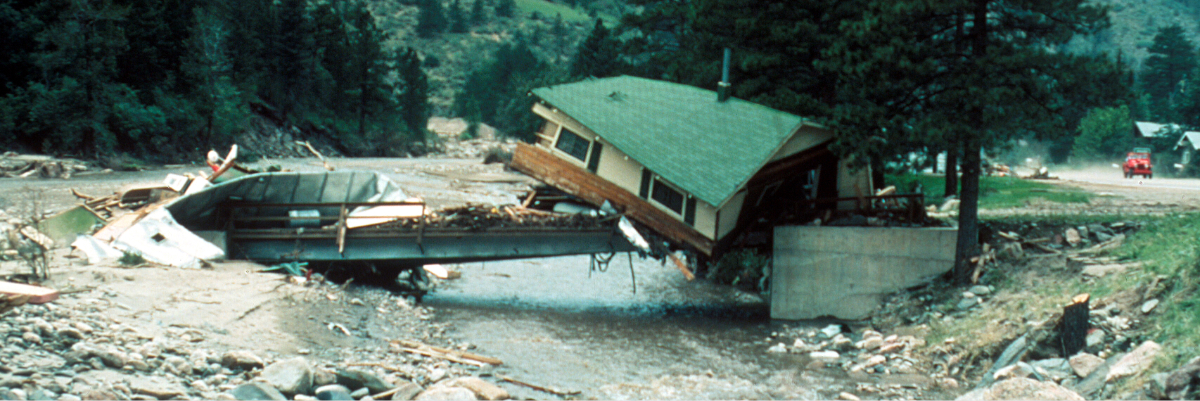 A cabin that was torn from its foundation by the Big Thompson Flood and lodged on a bridge just downstream from the community of Drake, Colorado. Source: W.R. Hansen / The U.S. Geological Survey, August 13, 1976.
Webinar Description
In the early evening on July 31, 1976, a powerful thunderstorm stalled over the Big Thompson Canyon, which stretches from Estes Park to Loveland, Colorado. The cloudburst dropped nearly a year’s worth of rain over course of a few hours, triggering a 20-foot surge of water that tore through the canyon, sweeping away homes, businesses, bridges, roads, and powerlines in its path and catching residents and tourists by surprise. More than 200 were injured, hundreds more were stranded until the floodwaters receded, and 144 people were killed. It remains the deadliest flood in the state’s recorded history.
The Big Thompson Flood was a turning point disaster in Colorado and beyond, inspiring transformational changes in flood research, forecasting efforts, early warning systems and risk communication, and emergency preparedness and response.
This webinar will bring together research and emergency management experts to mark the recent 50th anniversary of the Big Thompson Flood. They will engage in a reflective and wide-ranging discussion of how the disaster shaped research, policy, and practice.
Each panelist will share insights from their own work, with expertise spanning climatology to risk communication and emergency management. They'll also discuss lessons from the Big Thompson Flood that have been overlooked and opportunities to strengthen resilience to future floods and other natural hazards.
This webinar will be recorded and posted on the Natural Hazards Center website after the event. Please remember to sign up for future webinars and free resources here.
Speakers
Eve Gruntfest, professor emerita, University of Colorado at Colorado Springs
Lori R. Hodges, director of emergency management, Larimer County
Bob Jarrett, Flood and Paleoflood Science LLC
After registering, you will receive a confirmation email containing information on how to join the webinar.
Resources
50th Anniversary, Big Thompson Flood July 31st, 1976 - National Weather Service StoryMap
What People Did During the Big Thompson Flood
1976 Big Thompson flood, Colorado — Thirty years later

Eve Gruntfest is professor emerita in the Geography and Environmental Studies Department at the University of Colorado at Colorado Springs, where she was a faculty member from 1980-2007. From 2015-2017 she was a professional research associate at the Resilient Communities Institute at Cal Poly in San Luis Obispo, California. Gruntfest has published widely and is an expert in the areas of warning systems, flash flooding and integrating social science into atmospheric science. She received her PhD training at the University of Colorado Boulder under the Natural Hazards Center's founding director Gilbert F. White. One of her earliest publications focused on human responses to the Big Thompson Flood, and her dissertation focused on flood hazard adjustment in Denver and Boulder, Colorado. In 2014, the Association of American Geographers gave her the Gilbert F. White Service Award and in 2009 the American Meteorological Society honored her with the Kenneth E. Spengler Award.
Lori Hodges is the director of emergency management for Larimer County, Colorado—the epicenter of the 1976 Big Thompson Flood—with more than 30 years of experience in emergency services and emergency management at both the state and local levels. She is a frequent speaker on emergency management, leadership, organizational resilience, and the application of systems thinking to complex public-sector challenges. Hodges holds a PhD in Business Management with an emphasis in Strategy and Innovation, along with master's degrees in Defense Studies and Political Science and Public Policy. Her work focuses on complex adaptive systems, organizational strategy, and leadership in dynamic environments, with a particular interest in applying these concepts to emergency management. She has received the Larimer County Ranger Brendan Unitt Community Service Award, the Matthew’s House Volunteer of the Year Award, the Graduate Study Award from the University of Colorado and the Colorado Municipal League, and national recognition from the Civil Air Patrol for outstanding service.
Bob Jarrett has over 55 years of experience in flood hydrology and hydraulics, hydrometeorology, fluvial geomorphology, and paleoflood hydrology, specializing in mountain-river systems. From 1971 to 1974, Jarrett worked on flood hydrometeorology and hydraulics of the June 1972 Agnes Flood with the U.S Army Corps of Engineers in Buffalo, New York. From 1974 until 2012, he was a research hydrologist for the U.S. Geological Survey (USGS) in Lakewood, Colorado, and published over 80 scientific papers, including early studies of the Big Thompson Flood. Jarrett was the chief of the USGS’s National Research Program project “Paleohydrology and Climate Change.” Much of his career focused on integrating paleoflood hydrology in floodplain management, flood-hazard mitigation, dam safety, and related water-resources issues. From 2017-2020, he collected paleoflood data to help improve flood-frequency analyses at selected streamflow-gaging stations on the Colorado and Arkansas Rivers, and the Rio Grande for the State of Colorado. More recently, Jarrett works to assess the reliability of rainfall-frequency methods and flood-frequency methods in Colorado and the United States.