image/svg+xml
image/svg+xml
  • About Us
    • Our Center
    • Vision and Mission
    • Advisory Board
    • How to Contribute
    • In the News
    • Our People
    • Center Staff
    • Directors 1976-Present
    • Press/Contact Us
    • Subscribe
    • Our Awards
    • Mary Fran Myers Scholarship
    • Disability and Disasters Award
    • Student Paper Competition
    • Mary Fran Myers Gender and Disaster Award
  • Projects
    • Current Projects and Grants
    • Completed Projects and Grants
  • Training
    • Webinars
    • Disasters as Turning Points
    • NextGen Oil Spill Researchers
    • Making Mitigation Work
    • Trainings
    • CONVERGE Training Modules
    • Indigenous Sovereignty and Emergency Response
    • School Natural Hazard Safety Trainings
    • Mentoring Programs
    • NSF Enabling Program
    • Bill Anderson Fund
  • Workshop
    • 2026 Workshop
    • 2026 Researchers Meeting
    • 2026 Practitioners Meeting
    • Save the Dates
    • Past Workshops
  • Award Programs
    • Overview
    • Health and Extreme Weather Research
    • Quick Response Research
    • Mitigation Matters Research
    • Public Health Disaster Research
    • Weather Ready Research
    • Award News
  • Publications
    • Disaster Research - News You Can Use
    • Current Issue
    • Issue Index
    • Research Counts
    • Research Counts
    • Children and Disasters
    • Mass Sheltering
    • The Disaster Cycle
    • Equity and Inclusion
    • Research to Practice Publications
    • Publications Index
    • Legacy Publications
    • Research Award Programs
    • Research Reports
    • Research Briefs
    • Community Engagement Briefs
    • Our Scholarship
    • Books and Monographs
    • Journal Articles
    • Book Chapters
    • Dissertations
    • Theses
    • Director’s Corner
    • Director’s Corner Index
  • Resources
    • Disaster Events
    • Wildfire Publications
    • Tornado Publications
    • Hurricane Publications
    • Flood Publications
    • General Interest
    • Call Outs
    • Conferences
    • Jobs
    • Webinars and Training
    • Library
    • New Reads
    • Podcasts
    • Documentaries
    • Guidance
    • AI Policy
    • Style Guide
    • Accessible Presentations
    • Resource Lists
    • Journals
    • Book Series
    • Award Opportunities
    • Maps
    • Research Centers
    • SSEER
    • Listservs
    • Disaster Grads Listserv
  • Menu
image/svg+xml
  • Natural Hazards Center
  • About Us
    • Our Center
    • Vision and Mission
    • Advisory Board
    • How to Contribute
    • In the News
    • Our People
    • Center Staff
    • Directors 1976-Present
    • Our Awards
    • Mary Fran Myers Scholarship
    • Disability and Disasters Award
    • Student Paper Competition
    • Mary Fran Myers Gender and Disaster Award
    • Press/Contact Us
    • Subscribe
  • Projects
    • Current Projects and Grants
    • Completed Projects and Grants
  • Training
    • Webinars
    • Disasters as Turning Points
    • NextGen Oil Spill Researchers
    • Making Mitigation Work
    • Trainings
    • CONVERGE Training Modules
    • Indigenous Sovereignty and Emergency Response
    • School Natural Hazard Safety Trainings
    • Mentoring Programs
    • NSF Enabling Program
    • Bill Anderson Fund
  • Workshop
    • 2026 Workshop
    • 2026 Researchers Meeting
    • 2026 Practitioners Meeting
    • Save the Dates
    • Past Workshops
  • Award Programs
    • Overview
    • Health and Extreme Weather Research
    • Quick Response Research
    • Mitigation Matters Research
    • Public Health Disaster Research
    • Weather Ready Research
    • Award News
  • Publications
    • Disaster Research - News You Can Use
    • Current Issue
    • Issue Index
    • Research Counts
    • Research Counts
    • Children and Disasters
    • Mass Sheltering
    • The Disaster Cycle
    • Equity and Inclusion
    • Research to Practice Publications
    • Publications Index
    • Legacy Publications
    • Research Award Programs
    • Research Reports
    • Research Briefs
    • Community Engagement Briefs
    • Our Scholarship
    • Books and Monographs
    • Journal Articles
    • Book Chapters
    • Dissertations
    • Theses
    • Director’s Corner
    • Director’s Corner Index
  • Resources
    • Disaster Events
    • Wildfire Publications
    • Tornado Publications
    • Hurricane Publications
    • Flood Publications
    • General Interest
    • Call Outs
    • Conferences
    • Jobs
    • Webinars and Training
    • Library
    • New Reads
    • Podcasts
    • Documentaries
    • Guidance
    • AI Policy
    • Style Guide
    • Accessible Presentations
    • Resource Lists
    • Journals
    • Book Series
    • Award Opportunities
    • Maps
    • Research Centers
    • SSEER
    • Listservs
    • Disaster Grads Listserv
  • Login
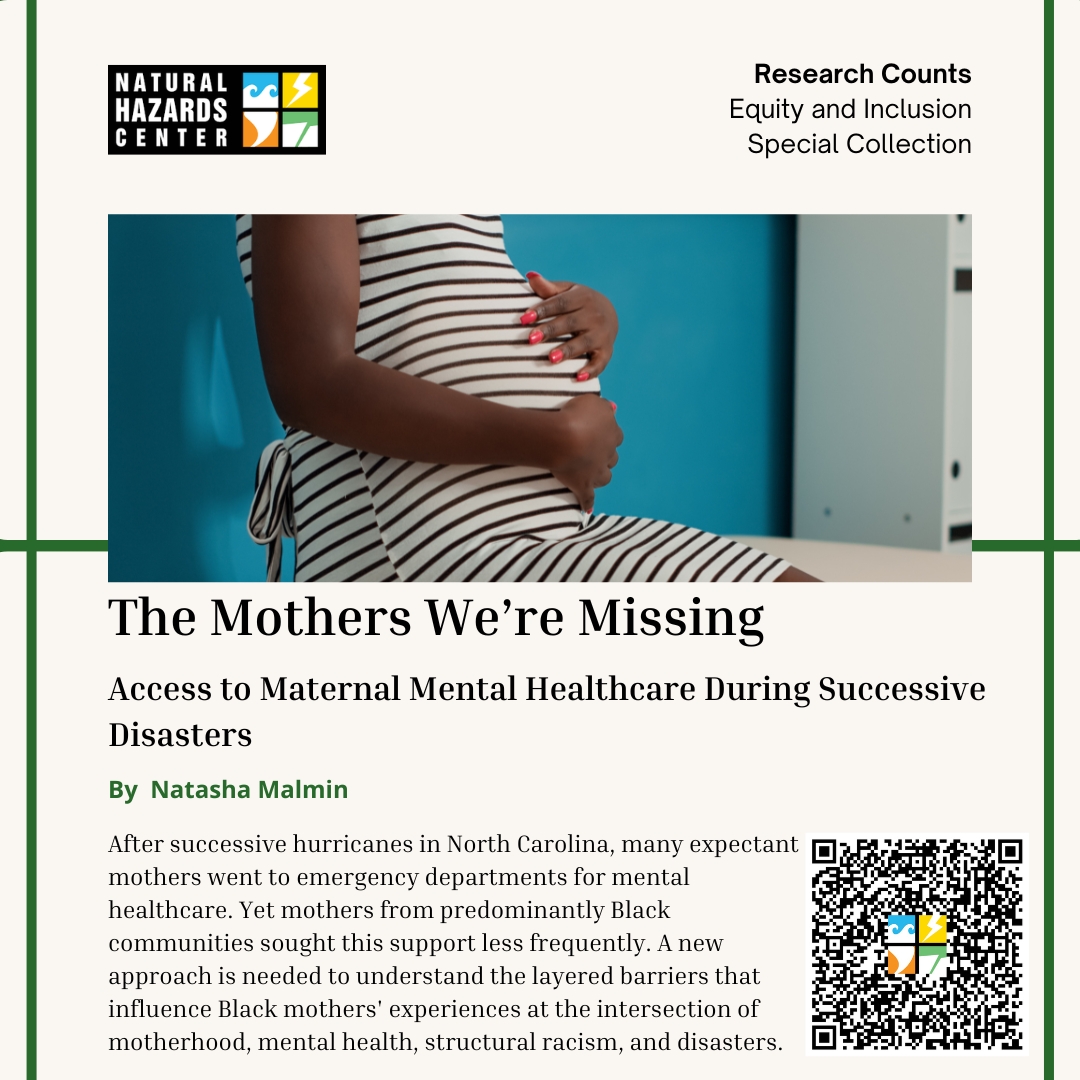
Climate change is contributing to more extreme weather, straining the already fragile last-resort systems meant to catch and support mothers.
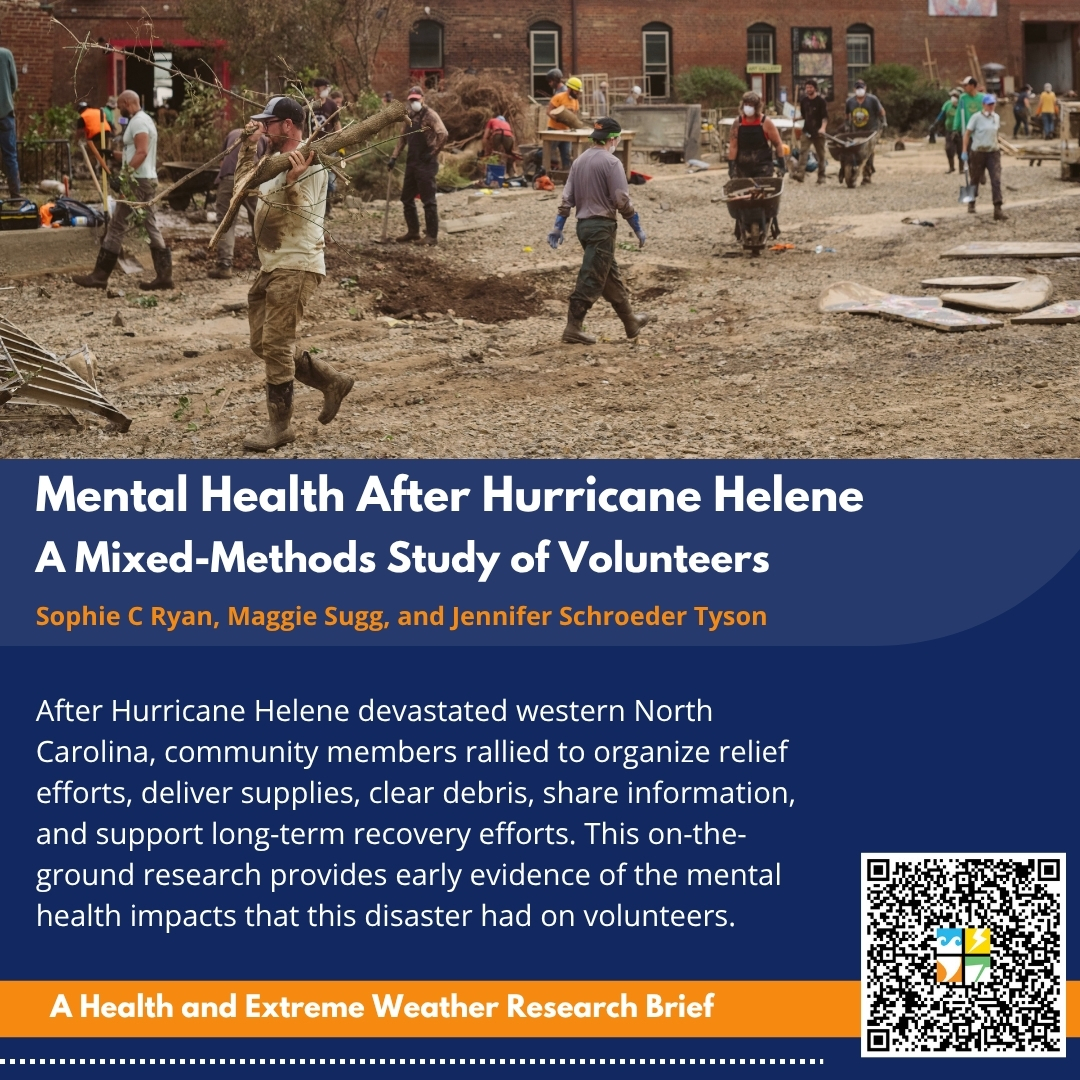
The latest Health and Extreme Weather research addresses gaps in understanding about mental health risk and resilience.
For Research Counts, Joseph Karanja and Tiffany Cousins argue that deeper consideration of local government capacity is essential to break cycles of underinvestment and help rural, under-resourced communities build climate resilience.
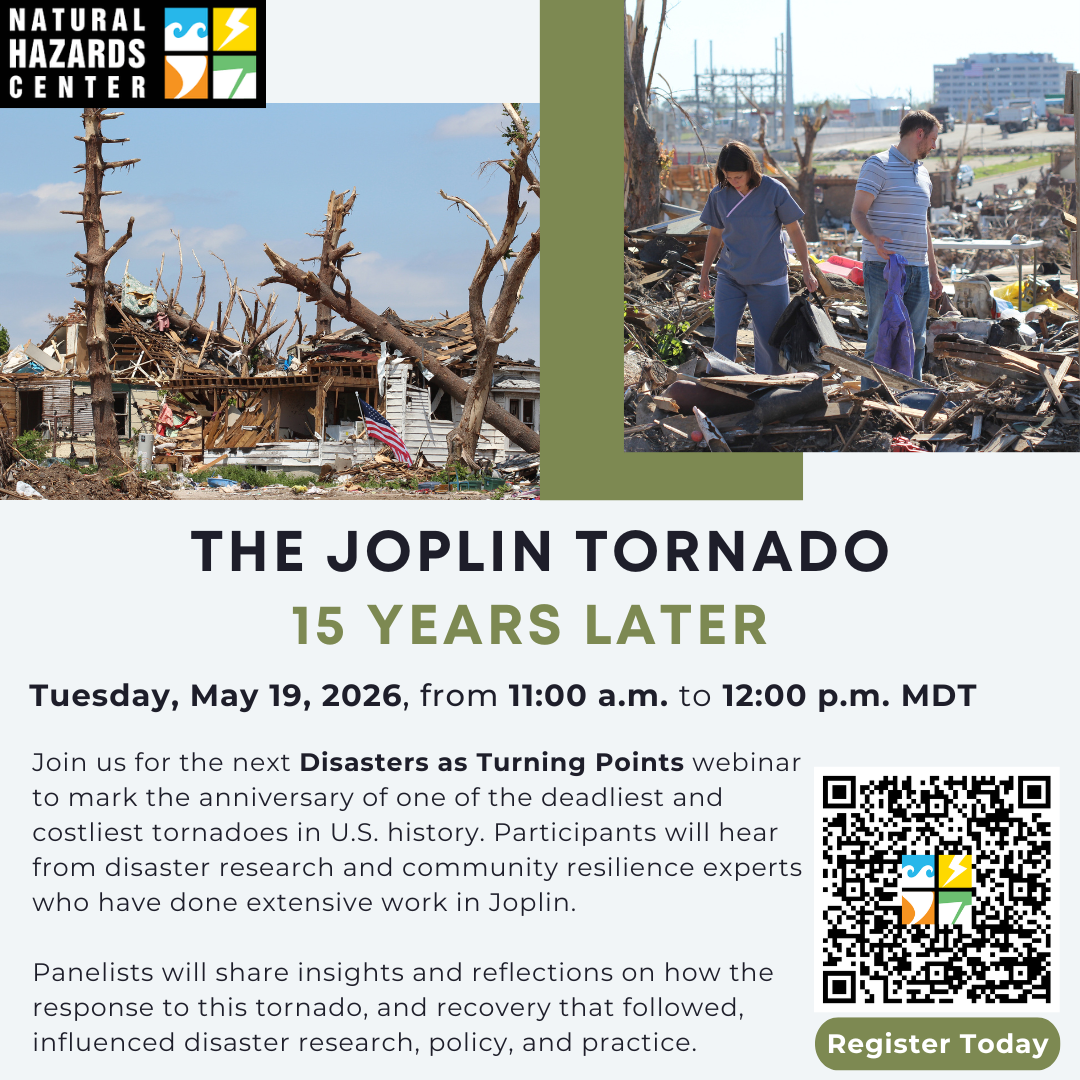
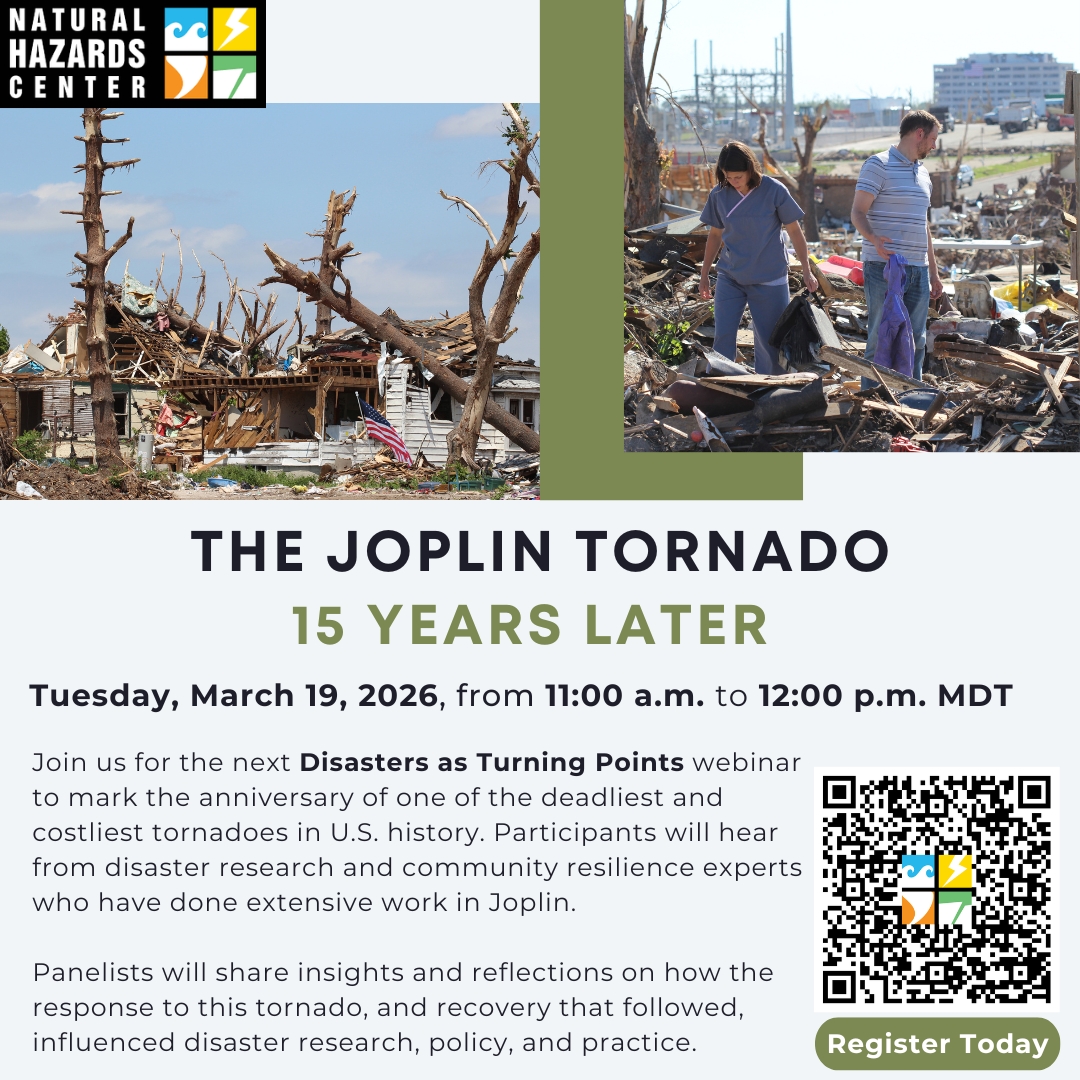
The Joplin tornado was a turning point disaster in United States history, revealing life-threatening vulnerabilities and inspiring profound changes in extreme weather preparedness, response, recovery, and resilience.
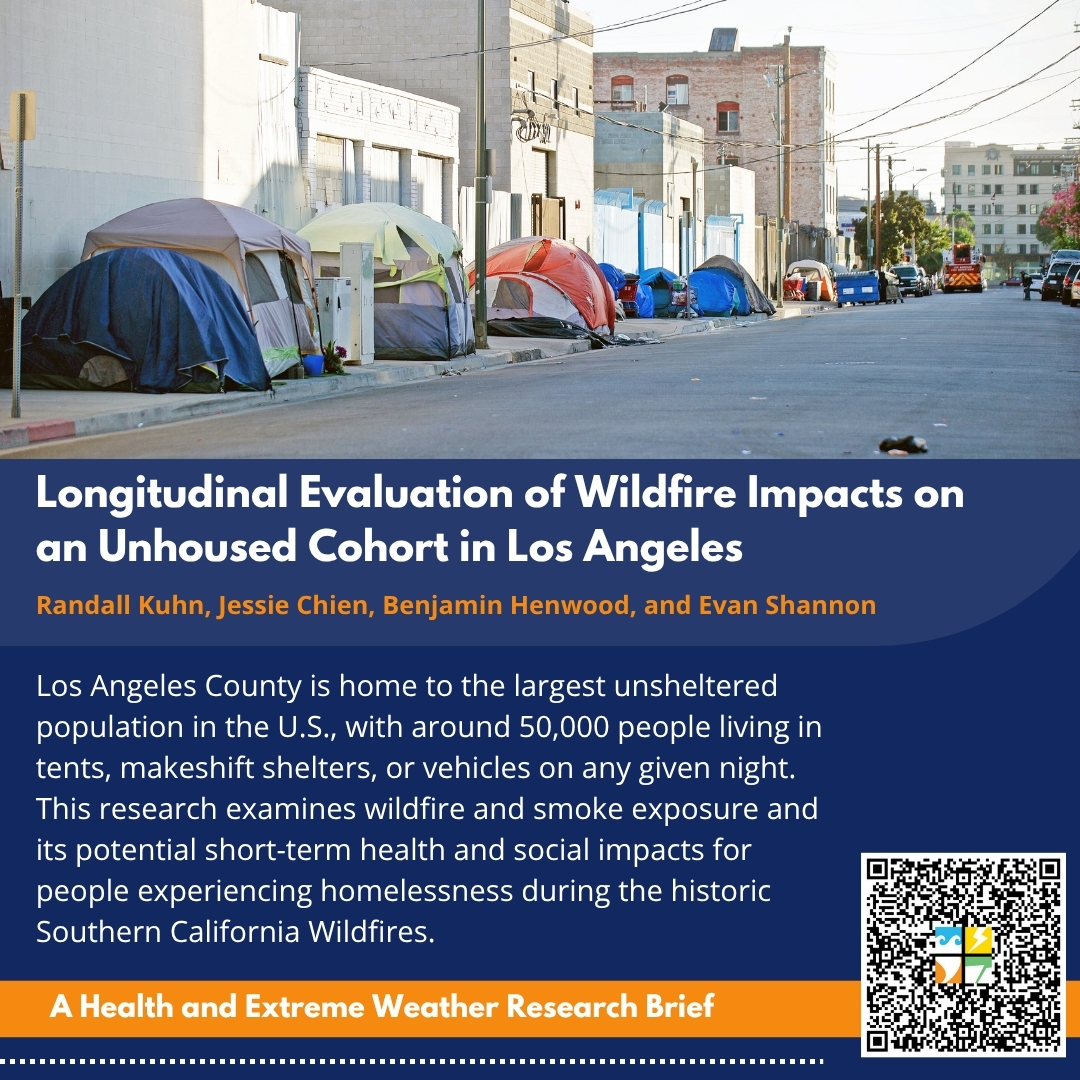
Homelessness is its own kind of crisis, which means people living without stable housing are especially vulnerable to disasters like the Southern California Wildfires.
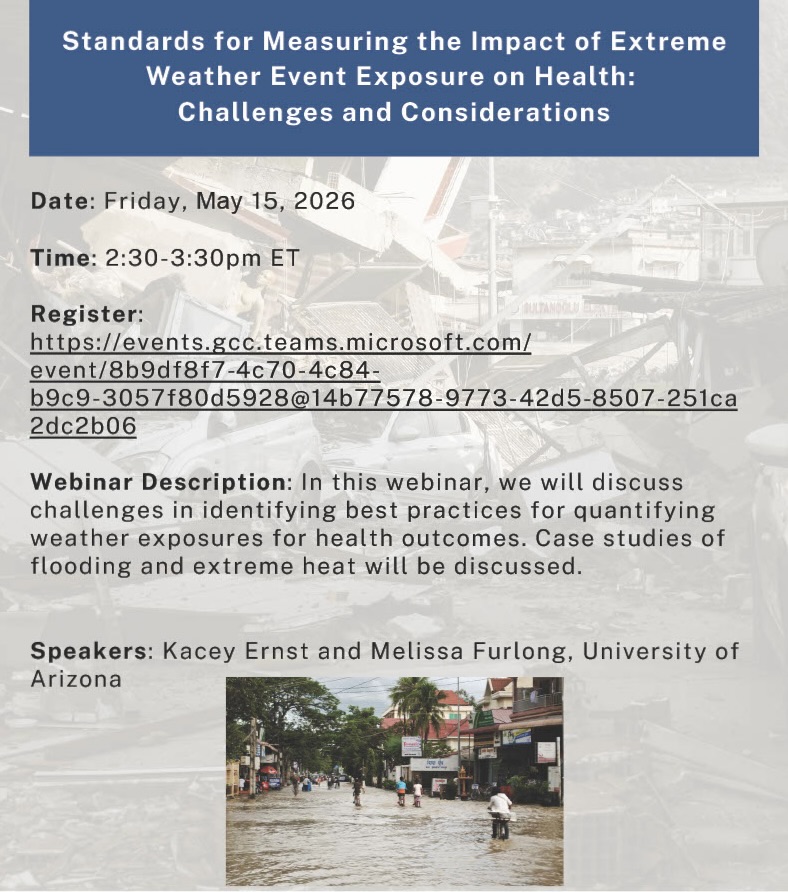
Join our partners at the National Institutes of Health for a Health and Extreme Weather Program webinar this Friday, May 15. Register today at the link in our bio.
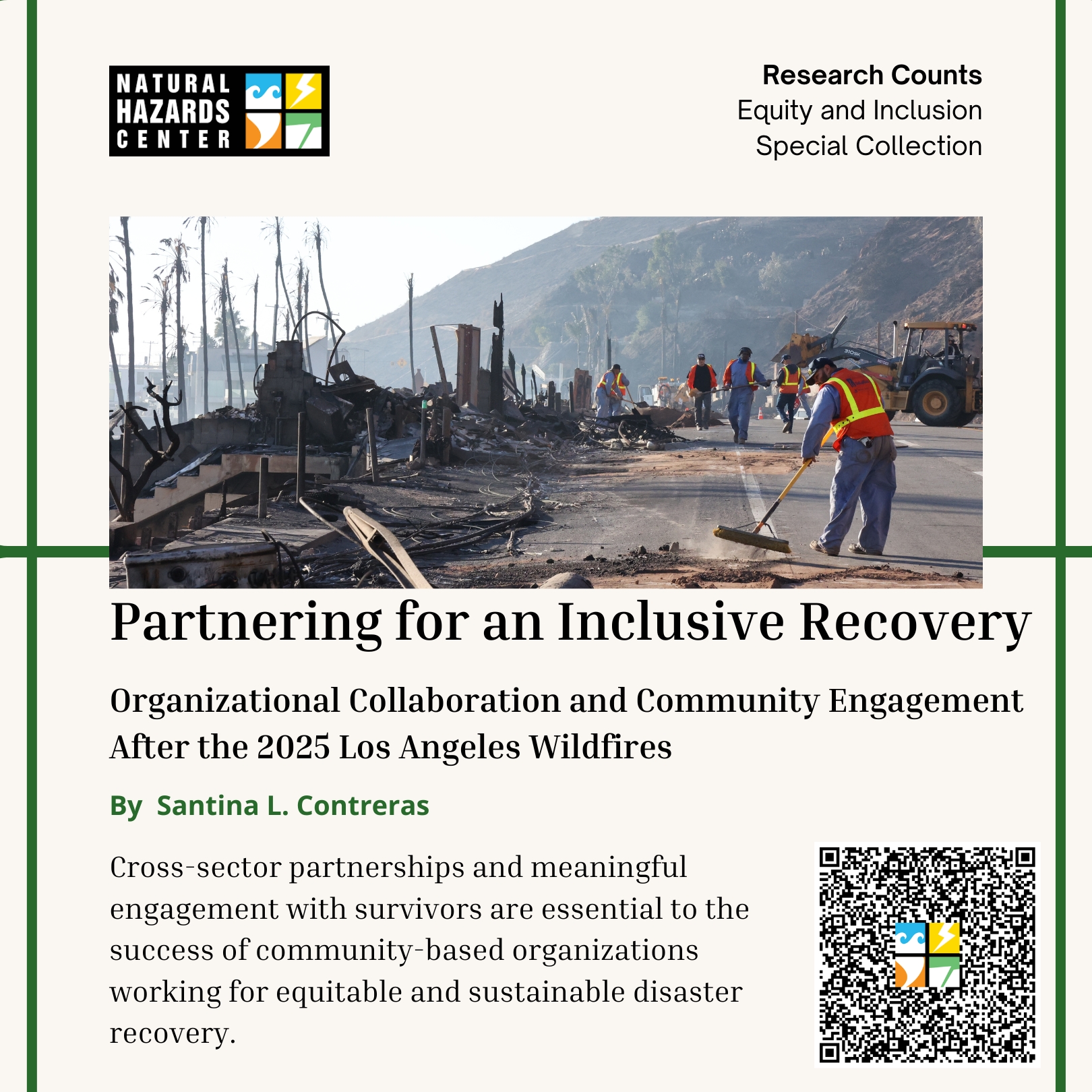
In the wake of the January 2025 Los Angeles wildfires, a diverse array of nonprofits, community-based organizations, and grassroots networks mobilized to help survivors across the heavily affected Pacific Palisades and Altadena communities.
The Joplin Tornado at 15, Disasters as Turning Points Webinar
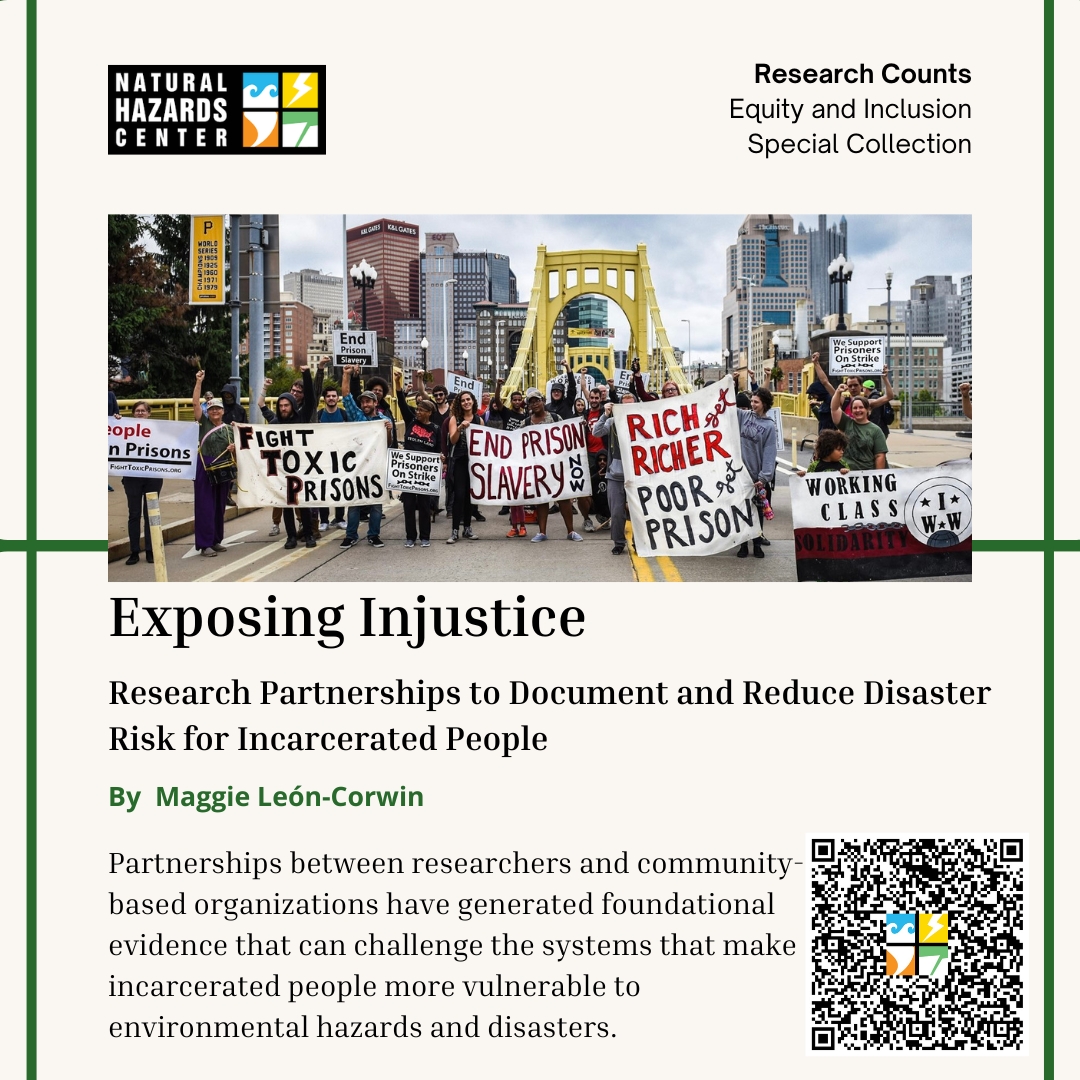
Incarcerated people face heightened disaster risk that remains largely invisible within systems designed to safeguard the public.
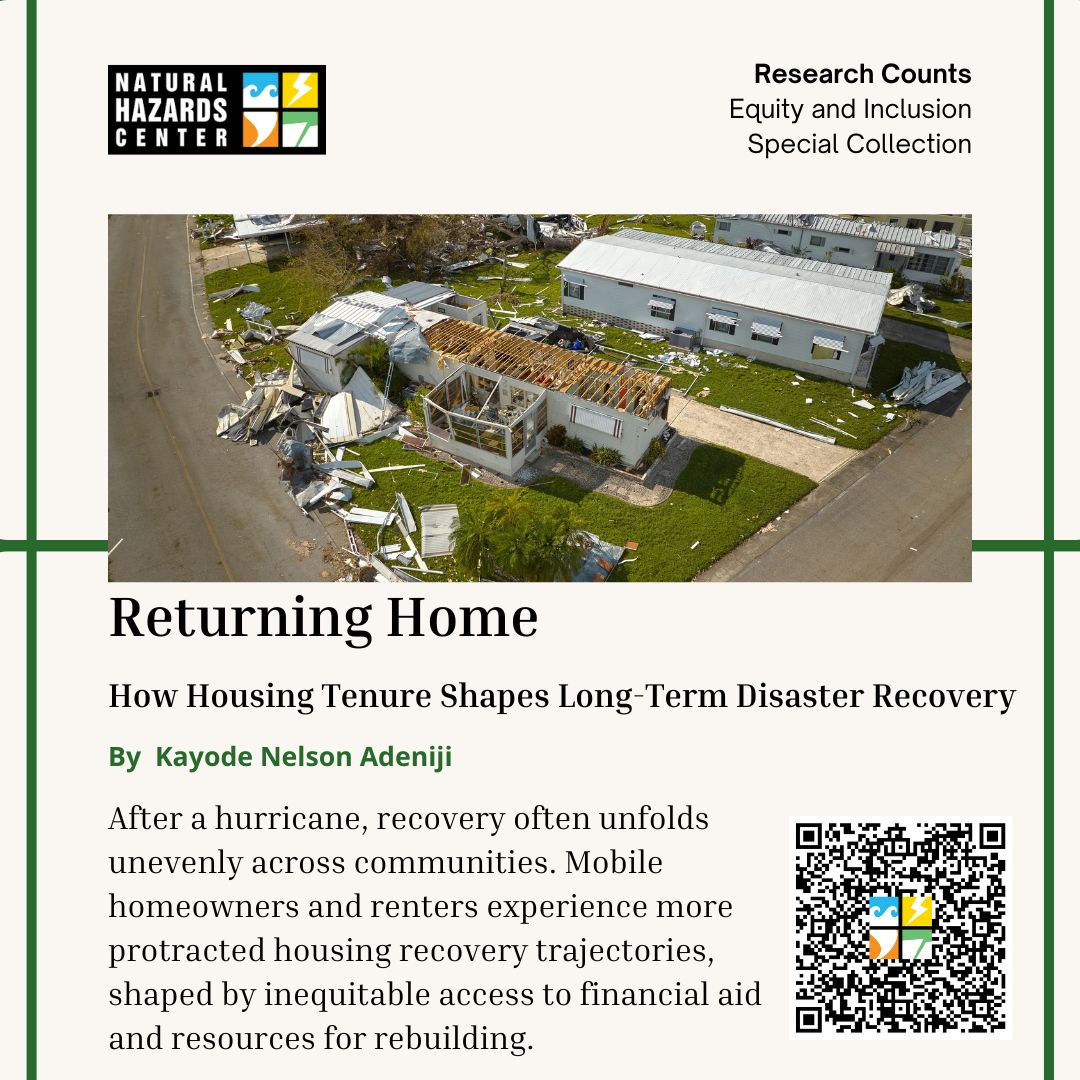
Rebuilding, repairing, or relocating in the wake of a disaster is time-consuming and expensive for all people.
Submissions for Research and Practice Highlights to be shared at the 51st annual Natural Hazards Workshop are due this Friday, May 1! Abstracts will be posted online for Workshop attendees to read and engage with.
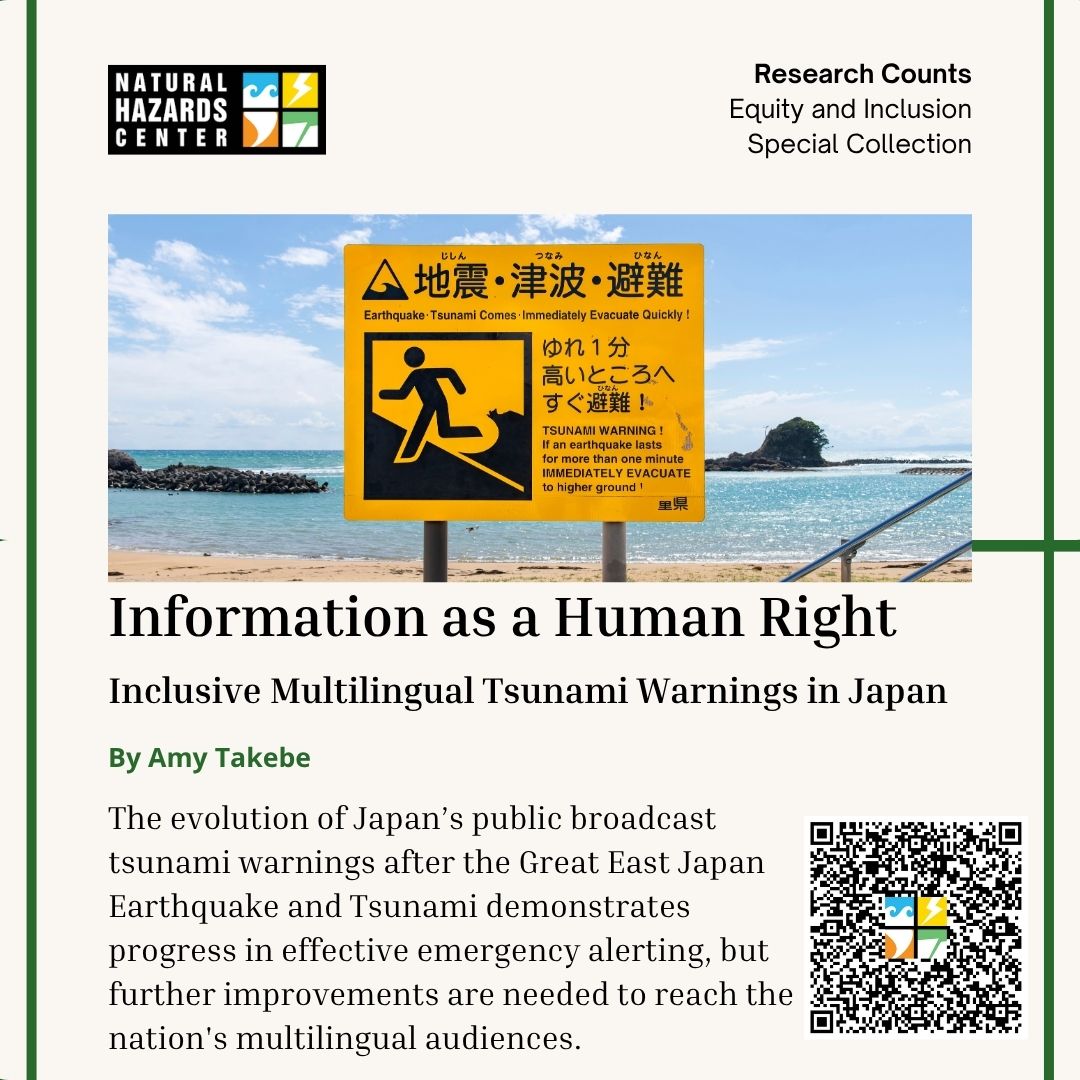
The challenge of communicating risk to culturally and linguistically diverse audiences is ever evolving.
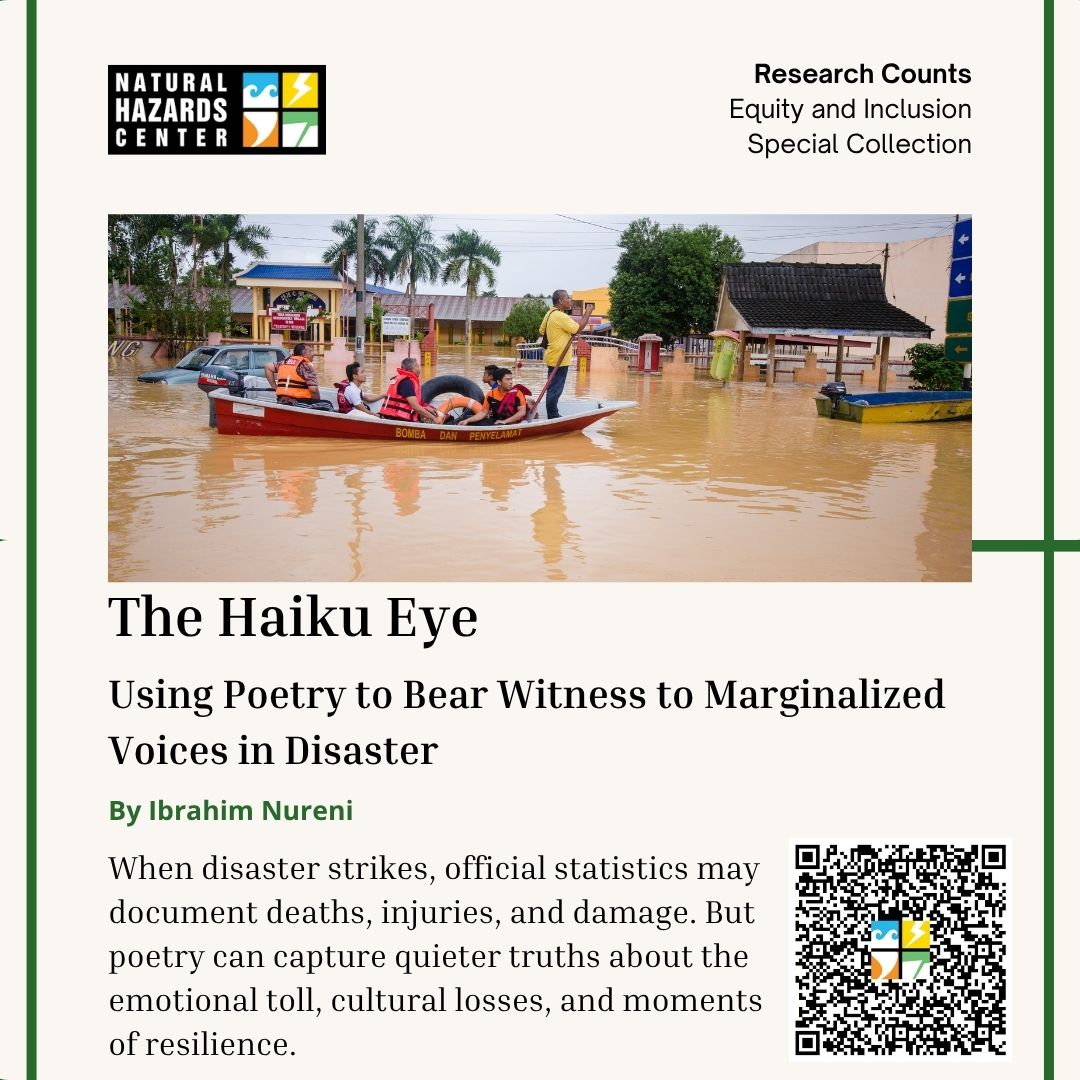
Haiku can be a uniquely powerful tool to bear witness to the often-invisible dimensions of loss and healing for people experiencing disasters. For Research Counts, Ibrahim Nureni proposes the "haiku-eye"—an inspiring new research perspective.
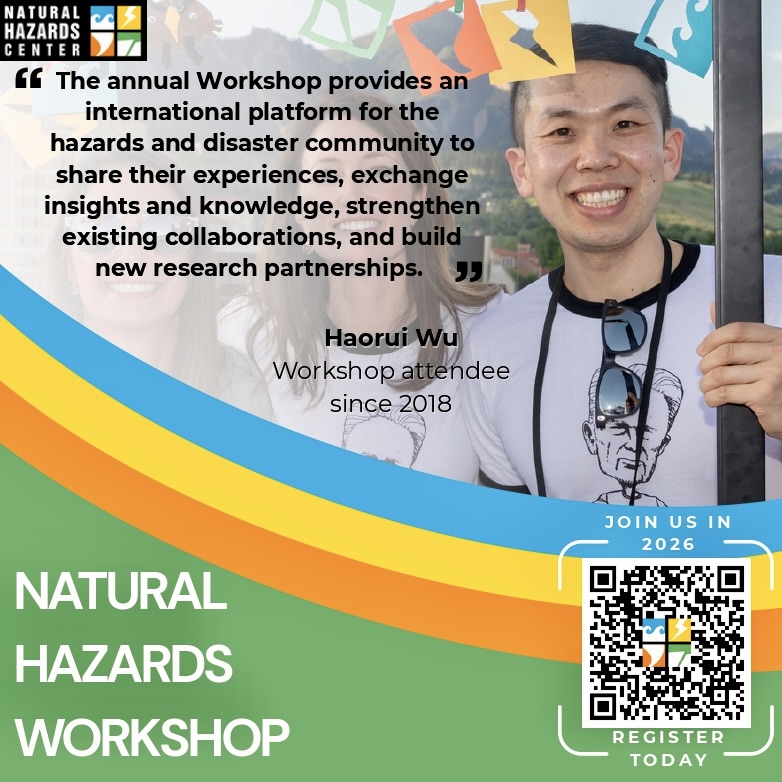
At the Natural Hazards Workshop, you can learn from experts working on hazards and disaster challenges around the world. As Haorui Wu can attest, it's just one of the many reasons to join us in 2026.
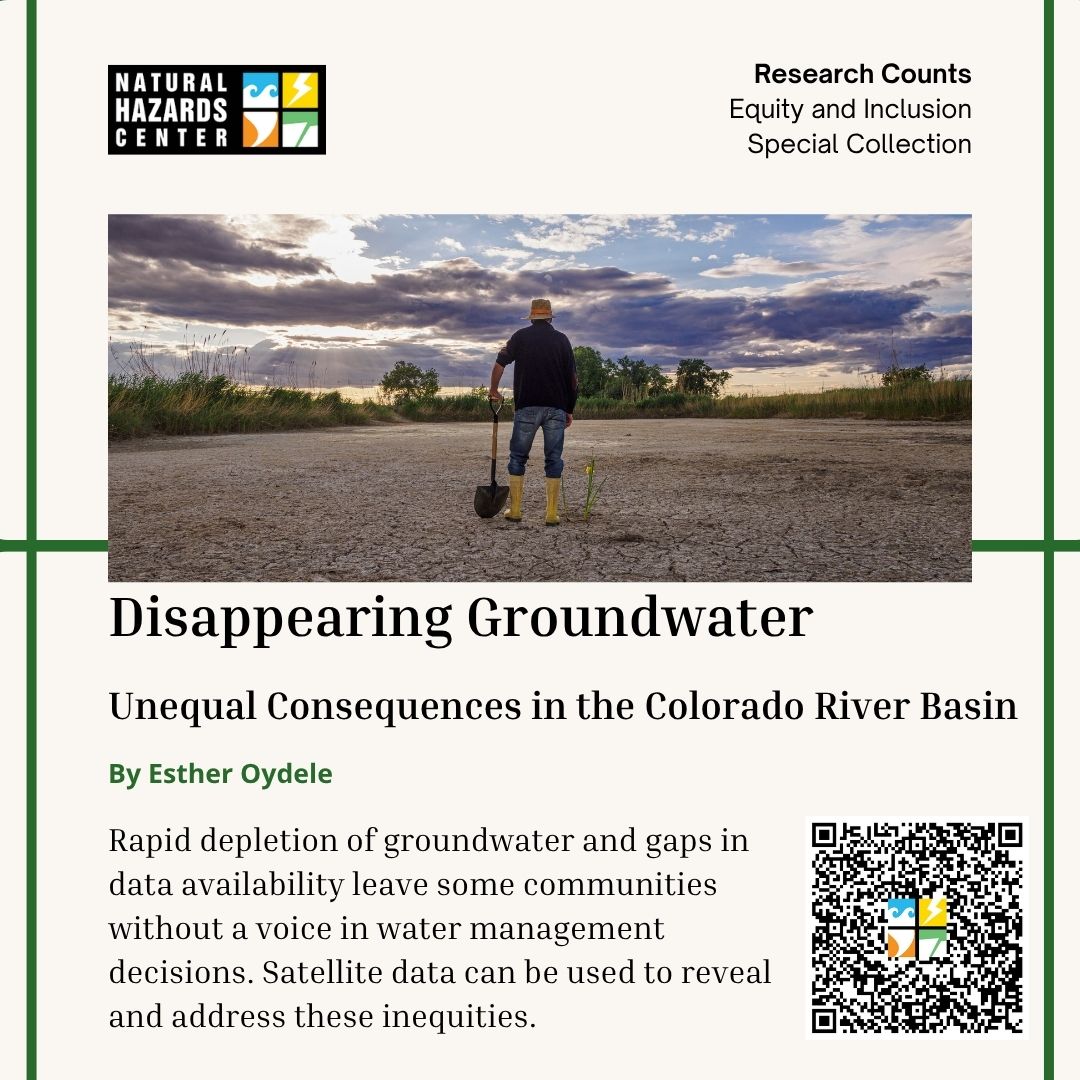
Groundwater in the Colorado River Basin is disappearing rapidly, unevenly, and unfairly. For Research Counts, Esther Oydele explains how satellite data can make hidden groundwater changes more visible.
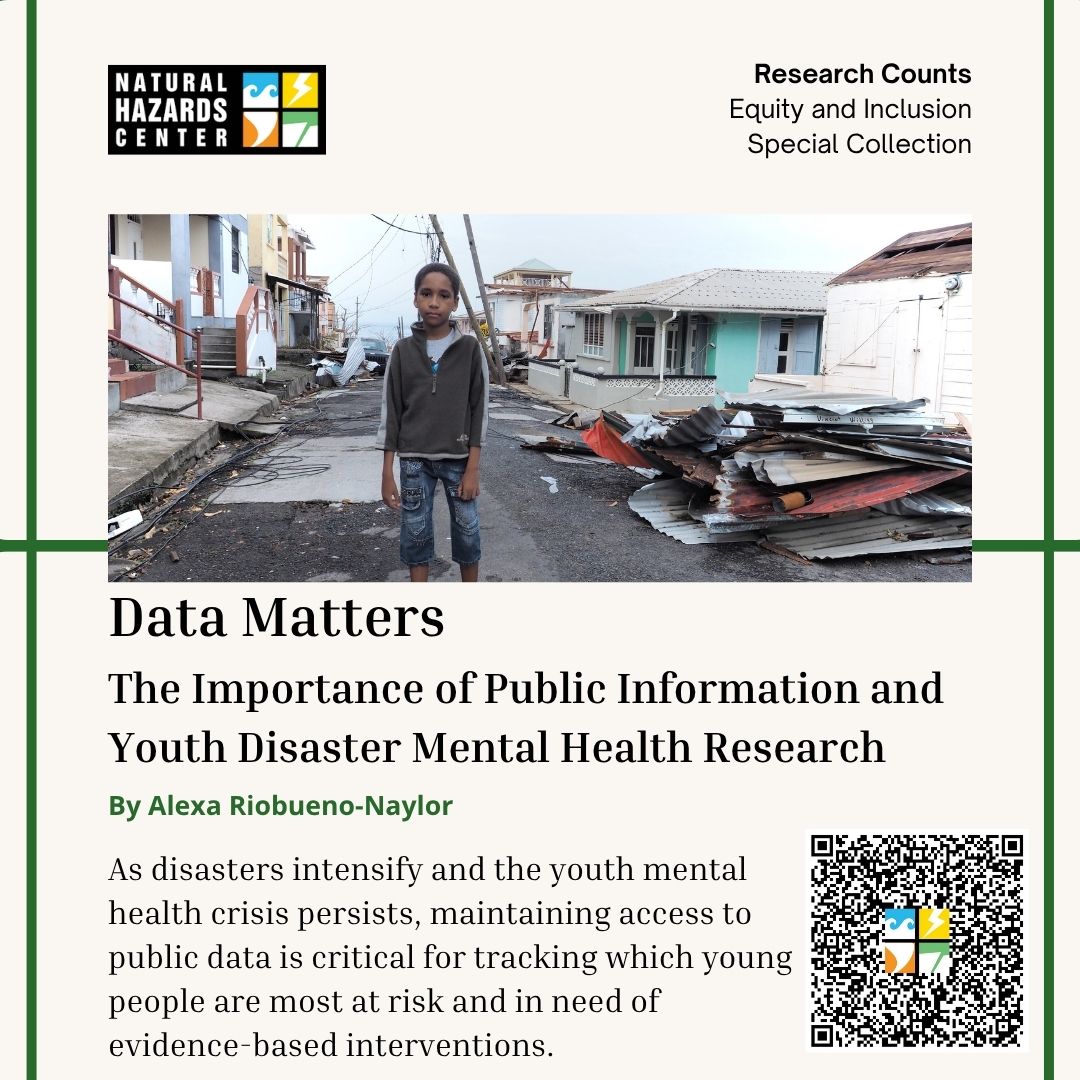
A child born today will experience several times more climate-related disasters than someone born in 1960. For Research Counts, Alexa Riobueno-Naylor explains how the future of youth mental health depends on safeguarding public data.
The annual Natural Hazards Workshop is a space for collaboration and imaginative work, where emerging scholars thrive.  Take it from Carlo A. Chunga Pizarro, who's been attending for nearly a decade. Register today!
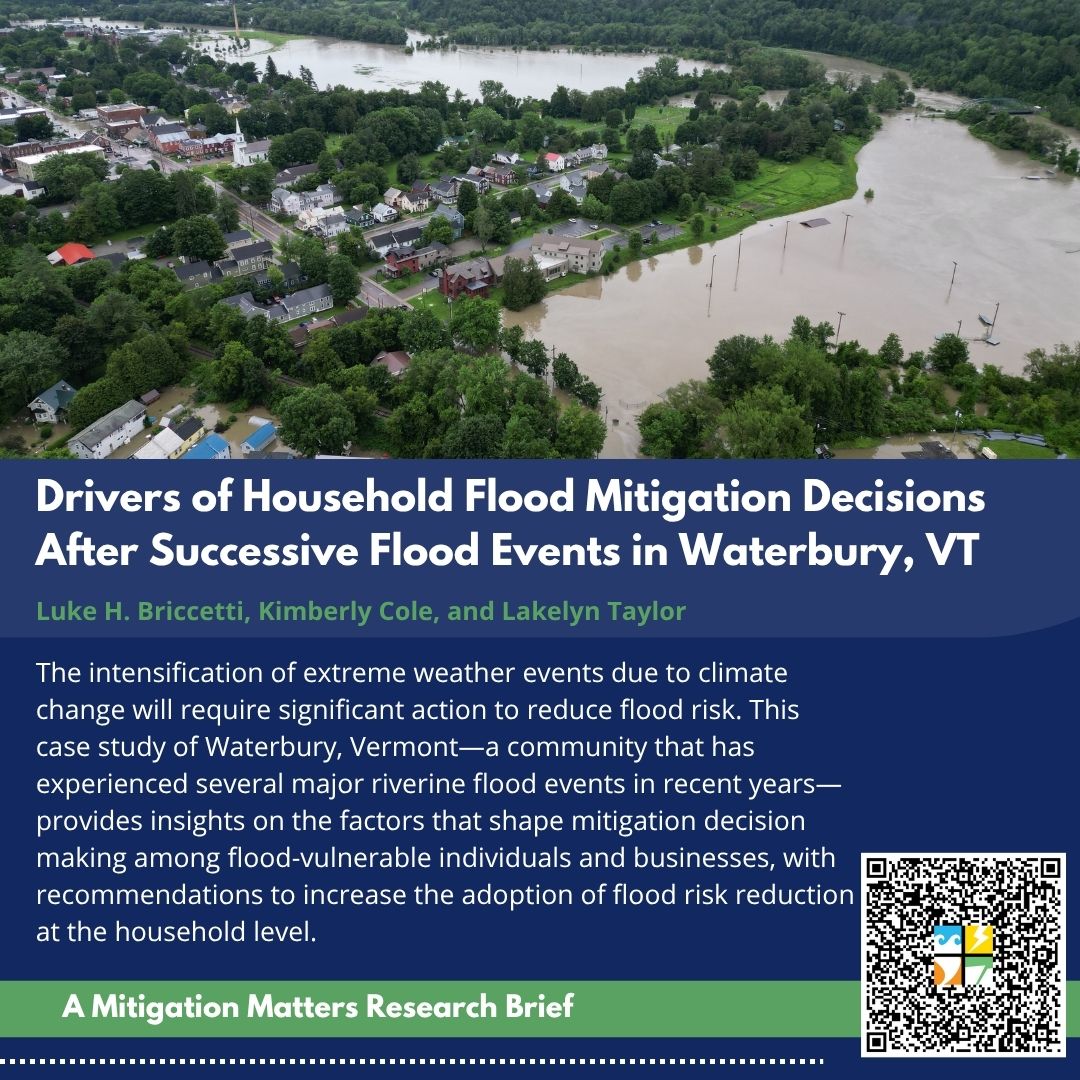
The latest Mitigation Matters research report provides insights to advance household risk reduction in communities facing repetitive floods.
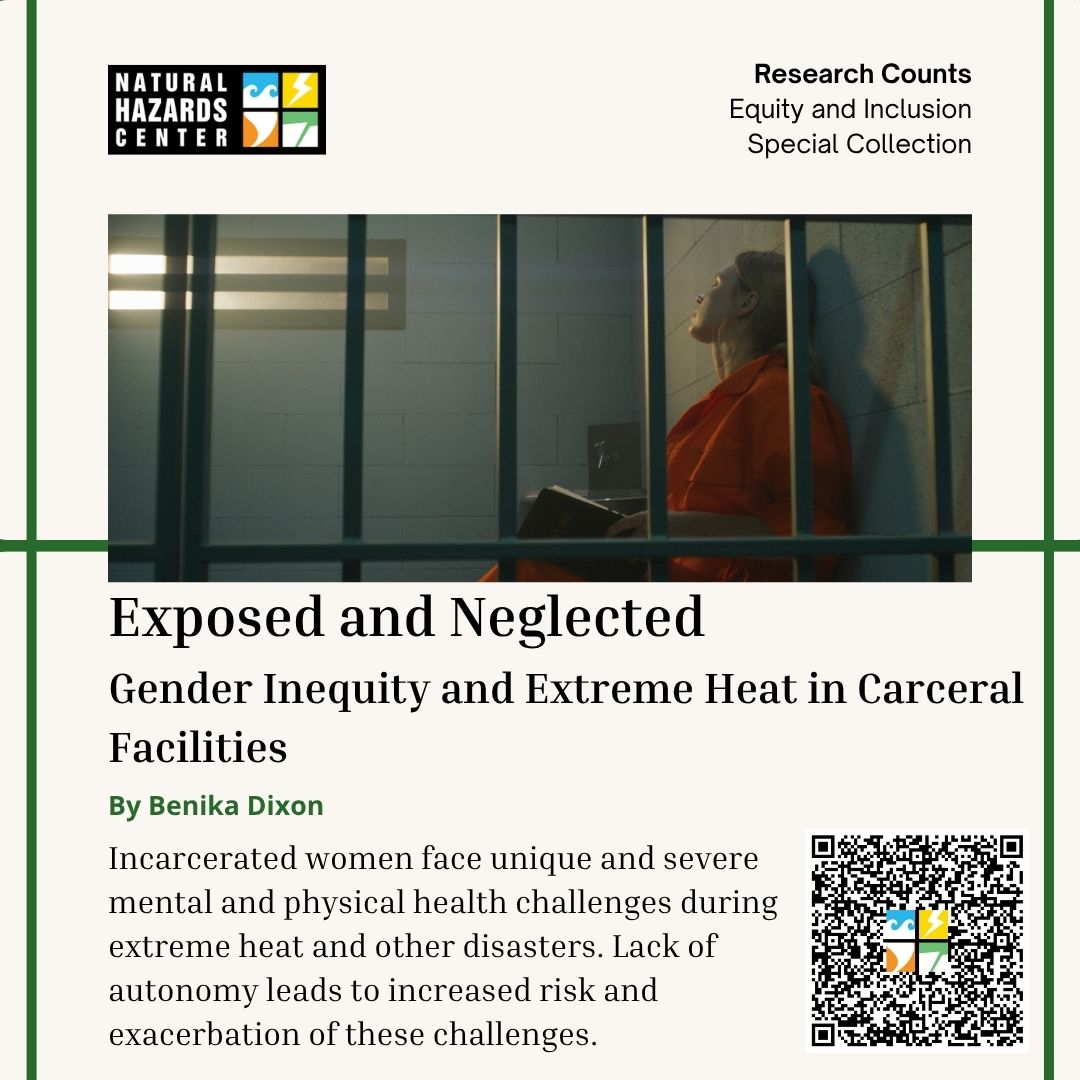
Extreme heat is increasing and most carceral facilities aren’t equipped to keep people cool. For Research Counts, Benika Dixon, examines the unique and disproportionate risks that incarcerated women face. Read it at the link in our bio.
The latest research from Natural Hazards Center researchers and collaborators calls attention to the facets of risk and loss that conventional measures of disaster impact may miss.
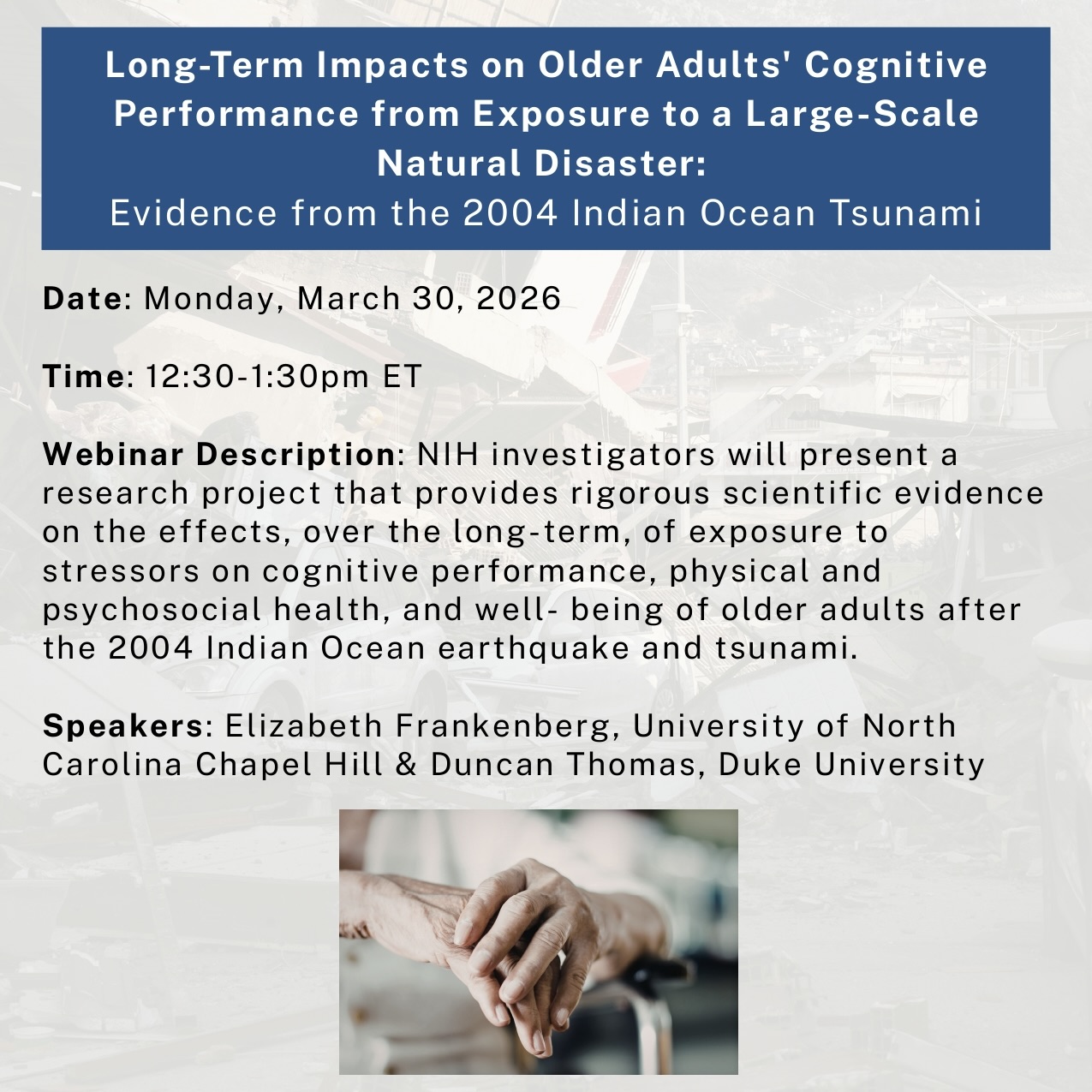
Tune in next Monday, March 30 to hear from researchers working with the National Institutes of Health to study critical intersections of public health and extreme weather.
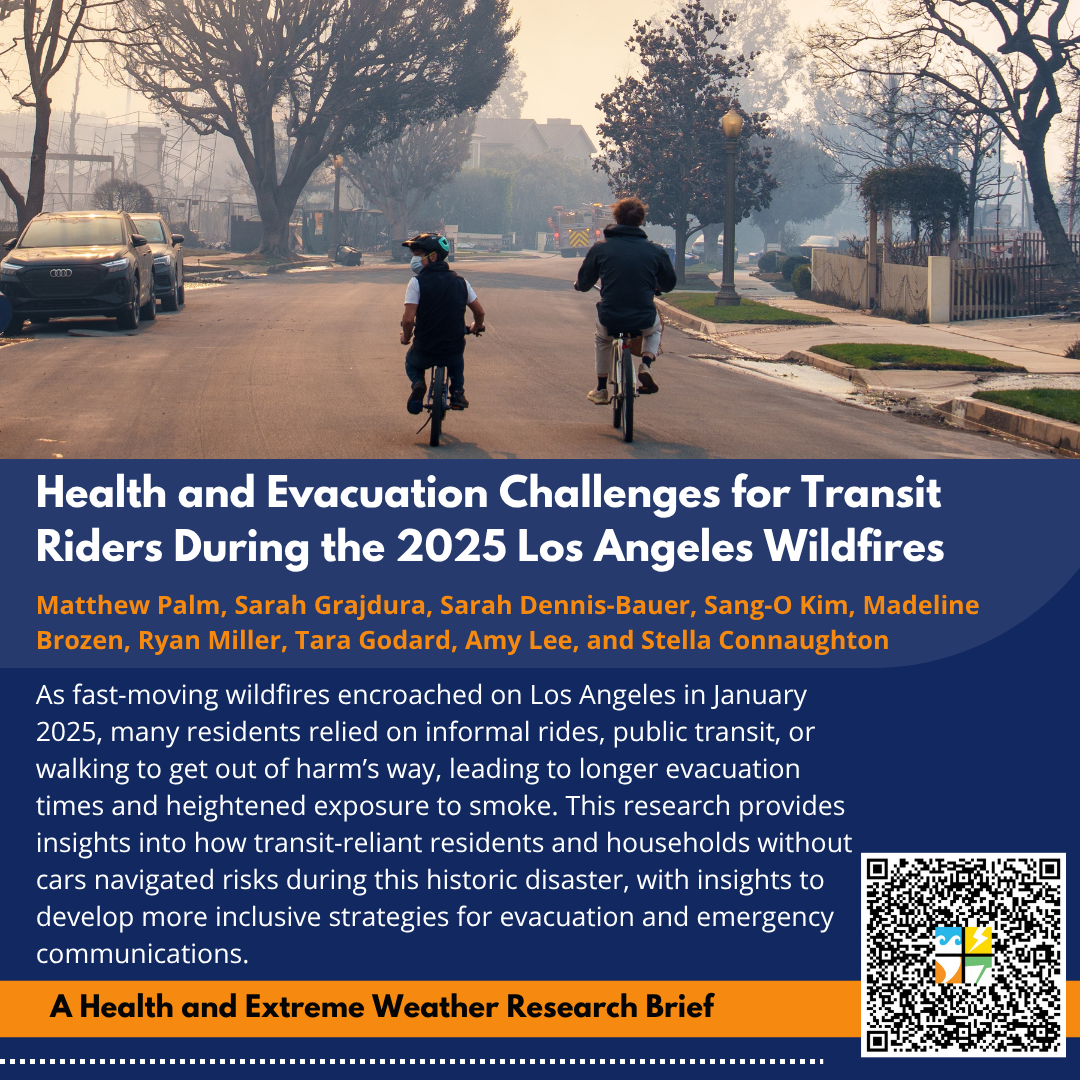
Equitable disaster planning requires acknowledging that tens of thousands of urban residents will not be evacuating by car.
No matter where your career take you, the annual Natural Hazards Workshop is a place to connect, learn, and enjoy some good food. Tell us what the Workshop means to you at the link in our bio!
Research is one avenue for a state legislature to build stronger evidence for policy. This case study examines a bill-sponsored research project to advance understanding of the state of emergency alerts and warnings in Colorado.
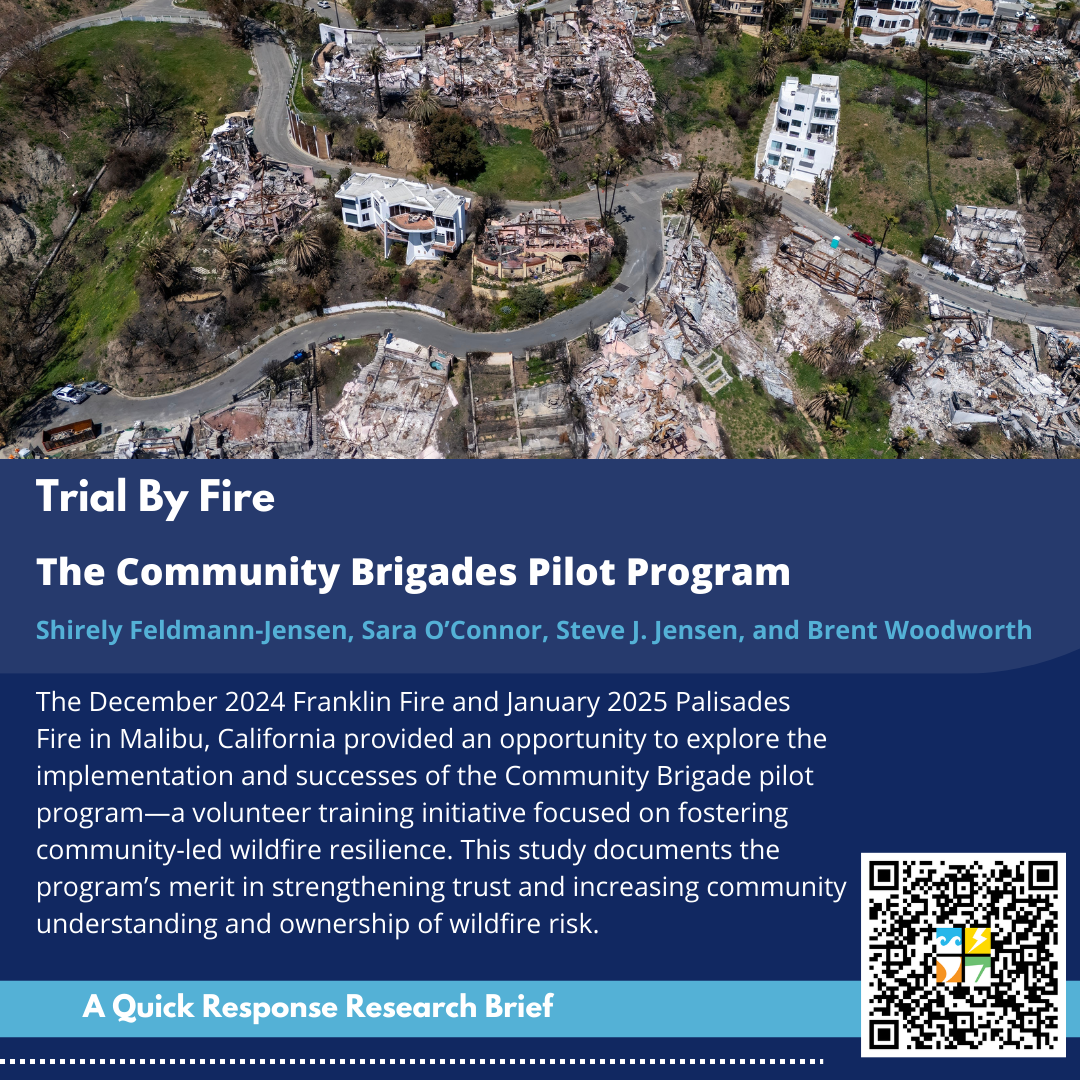
The Community Brigade pilot program was created to strengthen wildfire preparedness, response, and resilience in Malibu, California. The latest Quick Response study explores the program's success during recent wildfires.
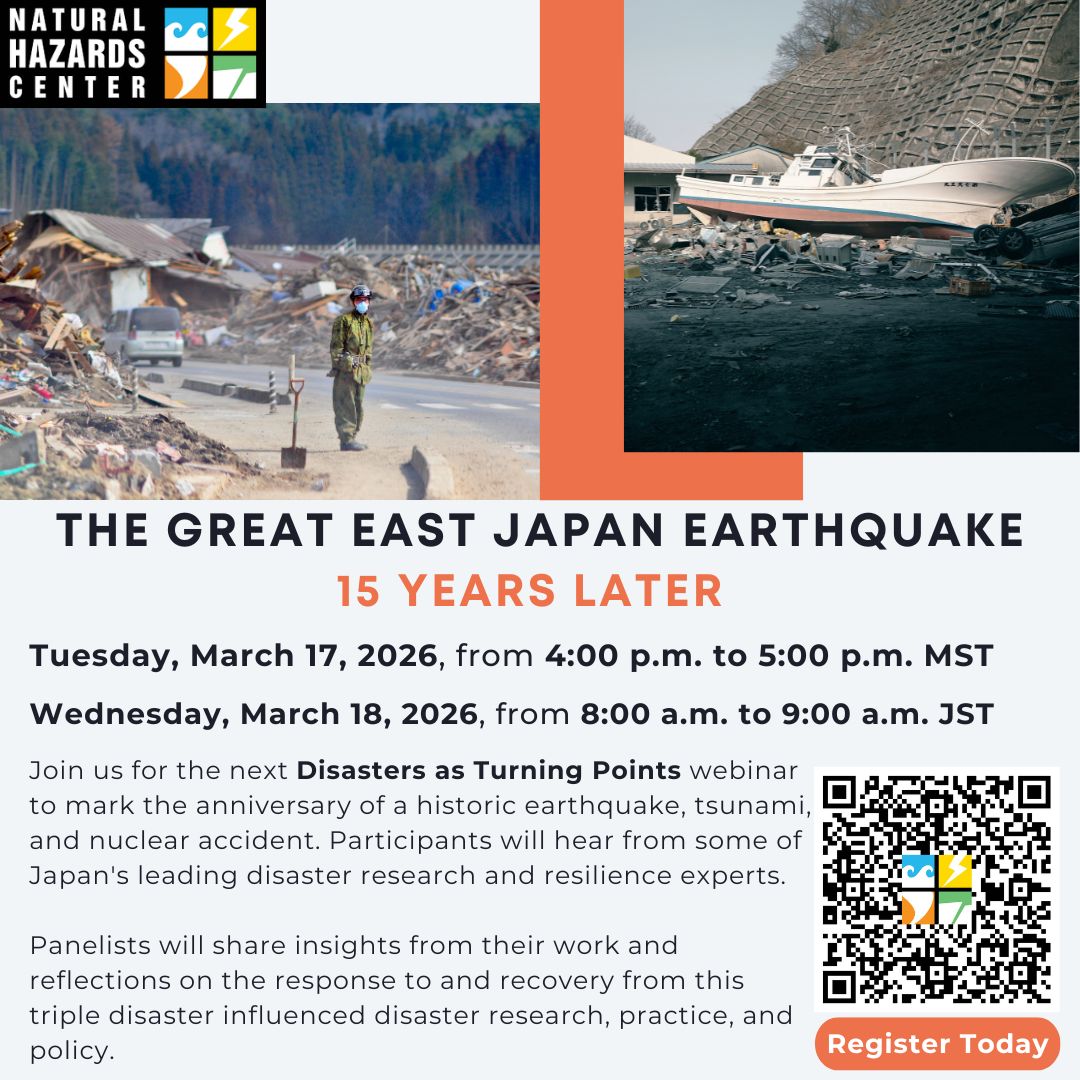
Join us on Tuesday, March 17, 2026 for a webinar to mark the anniversary of a turning point disaster.
This new study examines the emotional tolls of disaster research.
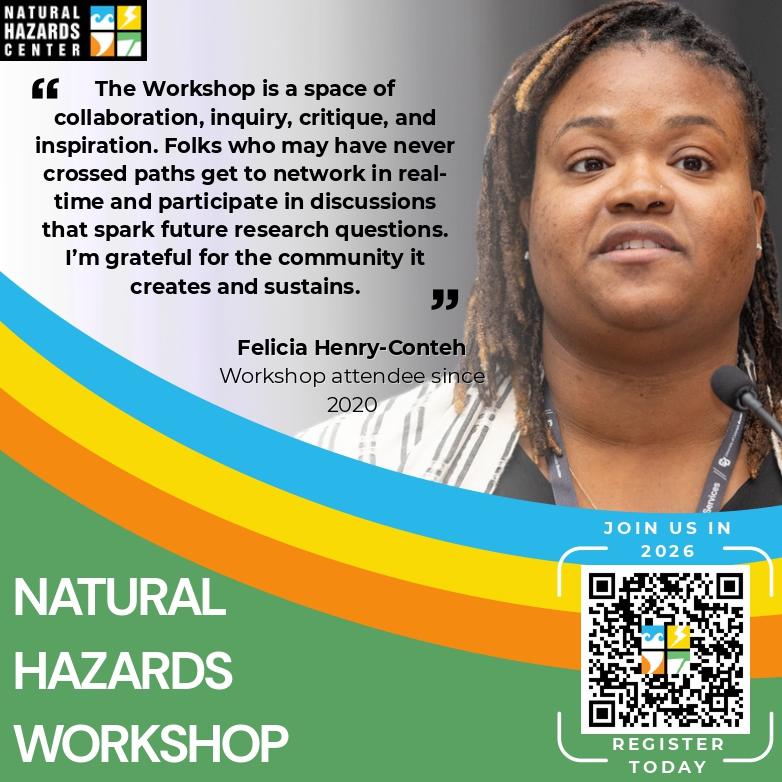
The annual Natural Hazards Workshop gathers people from across the hazards community who might not otherwise get to know one another. As Felicia Henry-Conteh, can attest, community is the Workshop's heart and soul.  We hope you'll join us this June!
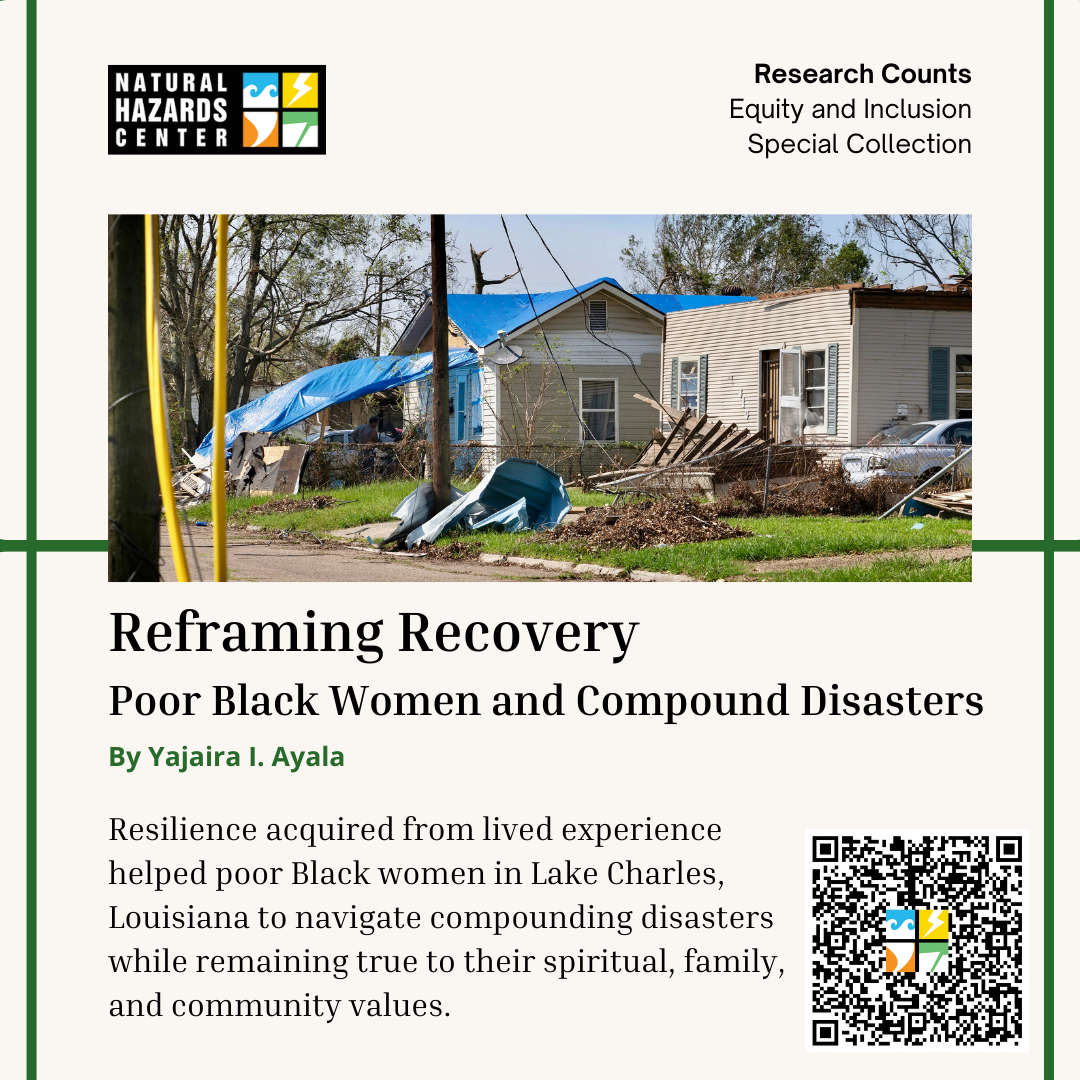
In 2020, residents of Lake Charles, Louisiana experienced both the COVID-19 pandemic and back-to-back Hurricanes Laura and Delta. For Research Counts, Yajaira Ayala explores how poor Black women navigated these disasters, with insights on resilience.
In April 2024, two heavy rain events caused significant flooding in Pittsburgh and surrounding areas, a region that is profoundly stricken by the opioid epidemic. The latest Health and Extreme Weather research explores how flooding affected patients.
The Natural Hazards Workshop is a place where students can find the confidence and support they need to grow into impressive scholars like Melissa Villarreal.  Tell us what the Workshop means to you at the link in our bio.
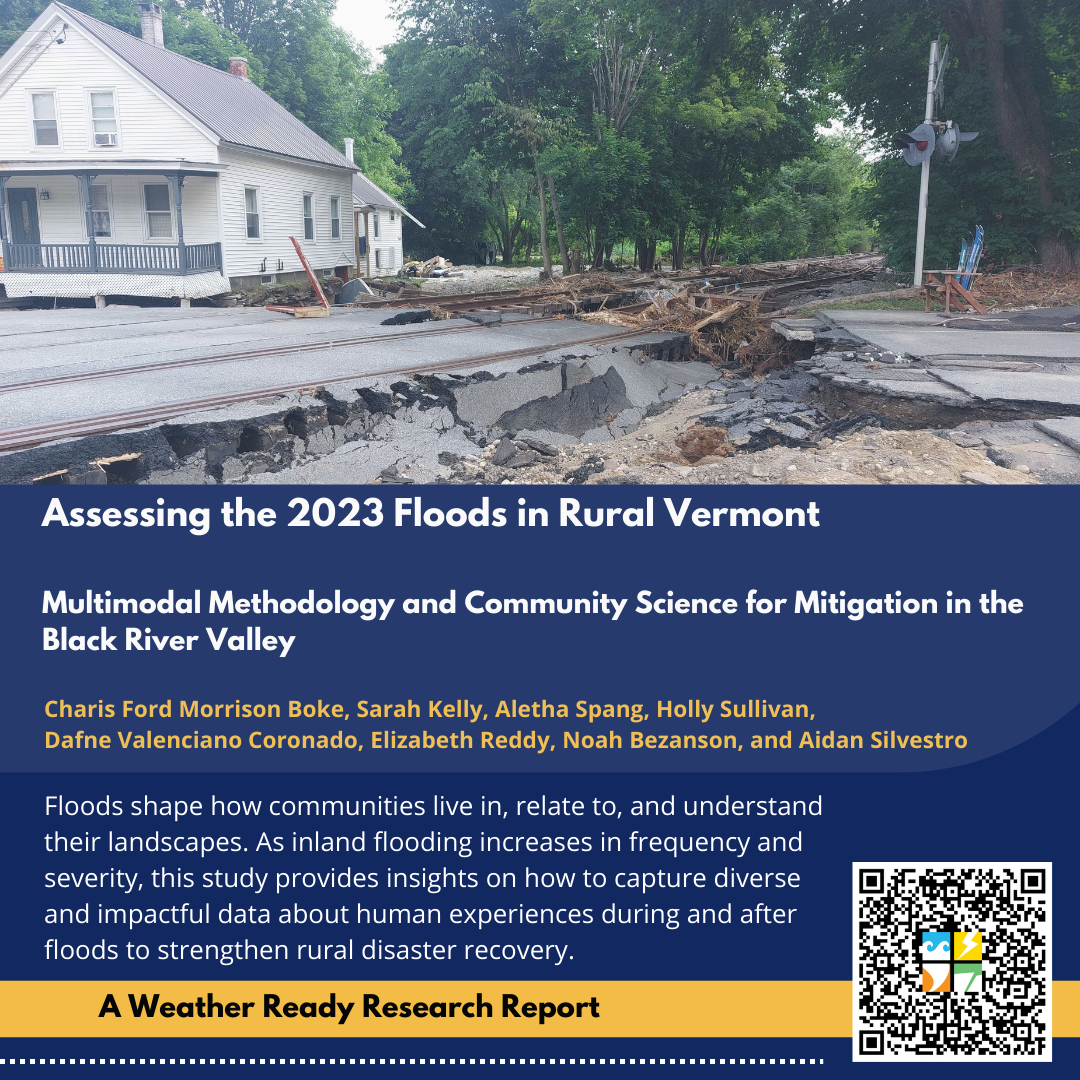
Understanding how people create and communicate knowledge about inland flooding is critical to supporting disaster response, recovery, and mitigation. This recent Weather Ready Research explores rural residents' experiences during 2023 floods.

Natural Hazards Center

483 UCB

Boulder, CO 80309-0483

Contact us: hazctr@colorado.edu | (303) 735-5844

Login