Trial by Fire
The Community Brigades Pilot Program
Publication Date: 2026
Abstract
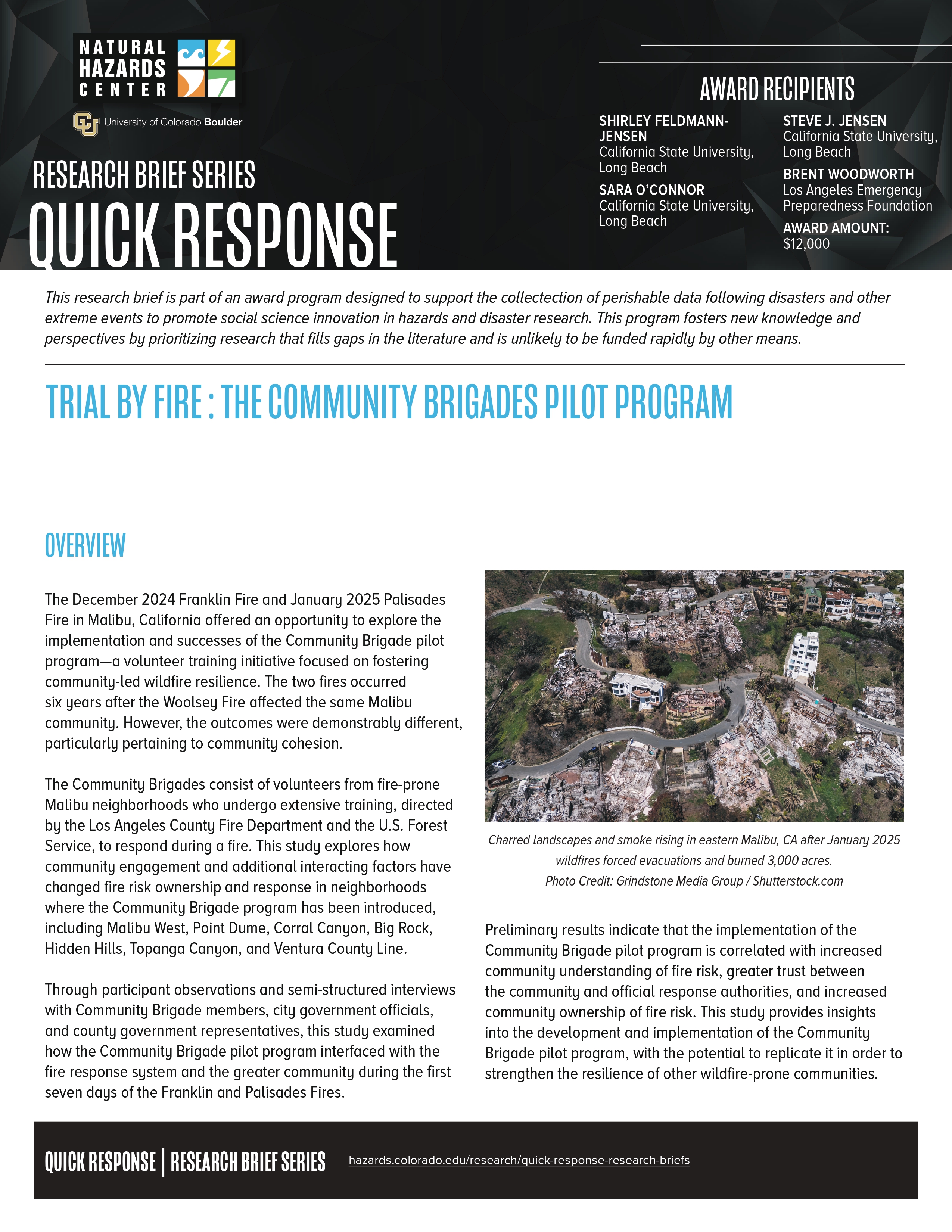
The December 2024 Franklin Fire and January 2025 Palisades Fire in Malibu, California offered an opportunity to explore the implementation of the Community Brigade pilot program— a volunteer training initiative focused on fostering community-led wildfire resilience. The two fires occurred six years after the Woolsey Fire affected the same Malibu community. However, the outcomes were demonstrably different, particularly pertaining to community cohesion. This study explores how community engagement and additional interacting factors have changed overall fire risk ownership and response for this community. Through participant observations and semi-structured interviews with Community Brigade members, city government officials, and county government representatives, this study examined how the Community Brigade pilot program interfaced with the fire response system and community during the first seven days of the Franklin and Palisades Fires. Preliminary results indicate that the Community Brigade's implementation is correlated with increased community cognition of fire risk, greater trust between the community and official response apparatuses, and increased community ownership of fire risk. This study provides insights into the development and implementation of the Community Brigade pilot program, with the potential to replicate it in other jurisdictions.
Introduction
Malibu, California, has a long and storied history with wildfire. While Malibu evokes images of beautiful coastline and an elite and often famous population, the city also has a significant frontier culture and a resilient, self-sufficient population. Their resiliency is due in no small part to their experiences with wildfire. Tapping into this posture towards self-reliance and the frayed relationship between the community and the government apparatus, our research team worked with the community, the Los Angeles Emergency Preparedness Foundation (LAEPF), and the Los Angeles County Fire Department (LaCoFD) to establish the Community Brigade pilot program.
The risk profile for Malibu, California has shifted significantly over the past few decades, requiring community members to adapt their lifestyles and activities to the realities of the recurrent fire hazards. Based on lessons learned from the 2018 Woolsey Fire, LAEPF worked with the community to develop a “Roadmap to Resilience” framework to create a path for collaborative, sustainable, and coordinated improvements to wildfire resilience. A cornerstone initiative was the development of the Community Brigade—a pilot preparedness, response, and recovery program organized through a partnership with the LACoFD.
The Community Brigade pilot program differs from traditional volunteer initiatives. The Community Brigades consist of volunteers from the community, who undergo extensive training, directed by LACoFD and the U.S. Forest Service, to respond during a fire. As opposed to “stay and defenders,” who defy evacuation orders, the community brigade pilot program has explicit ties to the governmental fire response apparatus and are trained and called into service when their assistance is needed. The partnership with LAEPF and LACoFD facilitates the brigades to work with communities, improve communication networks, empower local action, inform residents about effective fire risk reduction, and develop community brigade members who can be activated in large fires.
The pilot program leveraged the interest and capabilities of both public and private sectors in establishing the structure, standards, policies, legal framework, and training requirements for wildfire response. Pilot brigades were established in seven neighborhoods within the Malibu area: Malibu West, Point Dume, Corral Canyon, Big Rock, Hidden Hills, Topanga Canyon, and Ventura County Line. The brigades’ preparedness role centers on home ignition zones and hardening; their response role includes evacuation and ember control; and their recovery role involves acting as stewards of collective recovery. Their overarching role is to strengthen the flow of information between the residents and the official response system, which in turn promotes greater adaptability of all people involved.
The Los Angeles County Board of Supervisors and Los Angeles County Fire Department approved the Community Brigades pilot project shortly before the Franklin Fire of late 2024 and the devastating Palisades Fires of early 2025. During these recent fires, the Community Brigades members were integral to building trust and coordinating action between community and official responders.
Literature Review
Fundamental to building community resilience is understanding how the systems of the physical and built environments interact to create risk and recognizing that risk is interdependent with the social systems. Communities that can overcome damage, diminished productivity, and a reduced quality of life from an extreme event without significant outside assistance are considered sustainable (Mileti, 19991). The establishment of the Community Brigades is a step toward community ownership of the recurrent fire risk in the Malibu, Topanga, and Ventura County line communities. Achieving the required levels of sustainability in a dynamic environment presents a multi-factorial challenge, drawing on a wide range of research. Well-established coordination in the wake of a wildfire requires a risk-informed approach, whole community participation, and cognition of the problem severity for collective adaptive action.
Wildland-Urban Interface (WUI) Context
Although fire is a natural feature of the environment, its interaction with the built environment places people at risk. One in three California homes are located in the wildland-urban interface (WUI), which is defined as “the area where communities meet and intersperse with wildland vegetation” (Cohen & Butler, 19982; Cohen, 20103; Kolden, 20194). Communities in the WUI present unique challenges for firefighting, including, but not limited to, terrain, wide ranging population density, and complex, overlapping jurisdictions and responsibilities.
Fire risk in the WUI is influenced by the dynamic interplay between seven key factors (Jensen et al., 20195). The ever-changing conditions are a system where these primary factors must be addressed in concert for effective risk reduction: guiding shared action (governance), community, land use, environment and vegetation management, fire suppression, infrastructure, and home hardening and defensible space (Jensen et al., 2019). Each of these factors also have key social networks for information distribution, which is critical to reducing wildfire risk and vulnerability. However, these efforts are siloed in relationship to the risk factors, which can lead to critical misperceptions of the wider picture. Kolden (2019) identifies one way to overcome these silos is through engagement and action of community-specific, placed-based strategies.
A Risk-Informed Approach
The fact that risk is embedded in the social fabric of a given community means that the community itself has the power to reduce the risk (Tierney, 20146). The concept of risk implies a consideration of “possibilities and probabilities that lie in the future…of things that can go wrong and their impacts” (Tierney, 2014, p. 12). An example of community goals and strategies that can be embraced to promote a risk-centric approach include: inclusive community planning, promoting resilient infrastructure, resources targeting the most vulnerable in the community (such as older adults), and mitigating ignition zones and creating resilient spaces. Importantly, effective risk communication contributes to a shared understanding of risk and helps promote behavior changes, strategies, and activities to reduce disaster impact (United Nations Office for Disaster Risk Reduction, n.d.7).
Risk Governance
Governance is a society-centered view that incorporates a wide range of institutional arrangements by which we organize our collective lives. The term governance comes from the Greek “kuberna,” which means to steer or direct. Importantly, this broader view encourages capacity building in the community.
Another relevant term is “disaster risk management” referring to “the application of strategies and policies to prevent new disaster risk, reduce existing disaster risk, and manage the residual disaster risk, ultimately contributing to loss reduction, resilience building, and thriving communities” (Feldmann-Jensen et al., 20198, p. 23). The strategies of risk management apply to the broader community level as well. Overall, these ideas point to a focus on the community functioning as a whole for recurrent WUI fire adaptation.
Whole Community
Community can be considered a web of mutuality. A committed community can initiate action and then complement the legitimate government needs. Fire risk reduction can be accomplished in strengthening what already exists and increasing the connectivity between the community parts, so that it is better able to function as a whole.
Key elements in building community resilience involve collective cognition and collective action/civic participation. The voluntary aspect of this approach is embedded in the design. The capacity to build a collective understanding of the risk involves a shared goal for the welfare of the community with action toward that goal (Comfort & Wukich, 20099; Becker et al., 201110). Information and empowerment are paramount for a robust evolution of whole community (Kapucu, 201511).
Volunteer community efforts also enhance the wider response system. Das and colleagues (202512) show that “local people play an important role in the communication network and it is important to create opportunities for local people to connect and engage” (p. 18). At the same time, it is important to understand that the size of the city influences consistent volunteerism in public safety, which is also shaped by the fiscal and demographic characteristics of that community (Musso et al., 201913). Therefore, human and social capital costs are important considerations for the path forward in a collective action process.
Social Capital
In the context of disasters, social capital contributes to adaptation and resilience building. Social capital refers to “a social resource that provides its holder with some level of support and/or power through direct or networked social relationships” (Hackerott, 202014). The theories of social capital, adaptive capacity, and networks combine well to operationalize community resilience (Norris et al., 200815; Hackerott, 2020). Tierney (2014) validates that when social capital arises out of a community, it is well suited to address the unique community challenges presented by disaster.
Collective Action Foundations
Living realistically with today’s fire dynamics is essential to the Community Brigade areas of action. One role of the Brigades is to improve both the community’s cognition of risk and to bring this connectivity to the fire services. Cognition of risk is defined as “the capacity to recognize the degree of emerging risk to which a community is exposed and to act on that information” (Comfort, 2007, p. 18916). Further, decision points for each step of recognition are outlined by Comfort & Wukich (2009): (a) detection of risk; (b) recognition and interpretation of risk; (c) communication of risk to multiple organizations; and (d) self-organization and mobilization of the collective. Capacity for collective cognition of risk then enables the ability for collective action.
Another essential element needed for any collective action is trust. Developing relationships and trust is a vital pre-emergency practice, particularly when connecting public, private, and nonprofit entities. Further, Kapucu (200617) identifies that “social networks developed before disasters not only tie together responding organizations but also are less constrained by cross sectoral boundaries during emergency response” (p. 212). Complex adaptive systems literature provides an understanding here of the critical interaction between structure and process that fosters organizational learning and adaptation in dynamic environments.
The effective flow of information across organizational boundaries is critical in a dynamic disaster environment. The Community Brigades are a conduit of information during a fire response, informing community members about the current risk and necessary actions, as well as reporting back to the official response system for decision making. In network terms, organizational members who link their organization with the external environment are known as “boundary spanners” (Kapucu, 2006, p. 210; Beaven et al. 201718). Decisively, the boundary spanning role further enables continued alignment of actions to the shared goals.
Adaptation
In a disaster response, solving for wider system stability through adaptation and interaction is the key focus. In relating complex systems literature to emergency management, four relevant characteristics are identified:
A capacity for creative innovation among organizational units when they act as a system to achieve a common goal.
Relationships within the system remain flexible and put the overall goal first.
Interactive exchange between the system and its environment, with a mutual pattern of organizational learning which can be critical for a complex endeavor.
Information is critical for finding the right balance between order and chaos in a system, allowing a system to seek a stable balance in a dynamic situation (Comfort, 2007).
Applying complex adaptive systems concepts to disaster situations has been continually refined with a deeper understanding of “communication,” “coordination,” “control,” and “cognition” from studies of Hurricane Katrina (Comfort, 2007) and wildfires, such as the Camp Fire (Comfort et al., 201919). In practice, cognition is the least understood of these “4 Cs” but the most critical; especially, as pertaining to relationship of how the Community Brigades influence cognition in both the community and the official response system.
Coordinated action is possible when it is viewed as interaction between groups of people and their environment (Comfort, 2007). Adaptive resilience can also be a blend of novel and preplanned activities (Tierney, 2014). Together, these activities can provide evidence of community resilience. The Community Brigades are building resilience in the communities they live in.
Research Questions
This study fills a significant ‘knowledge into practice’ gap exploring the processes that affect community cognition of risk, as evidenced by communication integration and actions to reduce fire risk. In our efforts to fill this gap, we pose the following questions to guide this study:
How has the Community Brigade pilot program integration into fire response, since the 2018 Woolsey Fire, changed the cognition of the response structure?
In what ways does direct and pre-established involvement of the community enhance the risk cognition function?
Research Design
This study employs a qualitative interpretivist approach, as is appropriate for an exploratory and descriptive study looking at a recent and unique phenomenon. We collected data through semi-structured interviews, participant observation, fieldwork in the affected area, and archival review. The researchers conducted 18 semi-structured interviews with Community Brigade members, Malibu City government officials, Los Angeles County government representatives, and representatives of the Los Angeles County Fire Department. Participant observation occurred at three community brigade events, as well as two public meetings (one in person and one via Zoom) hosted by officials from the city government, federal agencies—including the Federal Emergency Management Agency (FEMA) and the U.S. Army Corps of Engineers—and congressional representatives’ staff members. The researchers were also granted access to the affected area in the company of Community Brigade members within a month of the Palisades Fire.
Study Site and Access
The development of the Community Brigade pilot program provided the researchers with the opportunity to develop deep ties to the community and contributed to the development of professional relationships with city government officials and county government representatives. The researchers work with the LAEPF, and the co-production of research products, including reports and presentations, have contributed to a long-standing working relationship built on mutual respect and reciprocity. The researchers have contributed to reports featured on the Los Angeles Emergency Preparedness Foundation’s website and consistently communicate with the Brigade leadership on how the research can assist with the Community Brigade’s further development. Further, the researchers advised the Community Brigades throughout the course of its six-year development and provided imperative insights into disaster response governance, assisting with the brigade’s recognition from the Los Angeles County Fire Department and Los Angeles County Board of Supervisors.
Additionally, the Geo-SpACE lab (geospatial analysis for community engagement) provided the Community Brigade pilot program with a critical geospatial analysis of their response activities. This series of maps allows the brigades to spatially visualize their activities over the course of the event. It allows them to assess the most used activities and resources and will inform future response activities.
Participant Observation
We conducted participant observations at two public meetings held by city government officials regarding the fire (one via Zoom and one in person) and at Community Brigade organized events. The observations occurred between January and June of 2025. City government officials hosted the meetings, which featured representatives from congressional offices, FEMA, the U.S. Army Corps of Engineers, the Los Angeles County Board of Supervisor’s office, and the Los Angeles County Fire Department. The meetings included short presentations by the Army Corps of Engineers and FEMA regarding the resources available to affected people, and the procedures for accessing resources. The presentations focused on how affected residents could opt in to hazardous material removal from their properties, and centered resident feedback. The researchers observed the events and took notes. No recordings or pictures were taken.
The LAEPF organized events included an appreciation lunch for Community Brigade members held at a local brewery shortly after the Palisades Fire, a wellness event hosted at a private residence, and an after-action meeting. At these events, the researchers took notes and did not make any recordings or take photos unless asked by the participants. At the after-action meeting, the researchers were asked to give a short presentation on their research to the members. Aside from this presentation, the researchers maintained an observational posture and did not participate in official proceedings.
Data Management
The researchers maintained field notes in notebooks and, after returning from the events, would transfer the notes to a digital Word document format. The field notes informed the interviewee list, the sampling strategy, and provided imperative context for the researchers prior to engaging in one-on-one interviews. Given that the researchers attended similar events in the aftermath of the Woolsey Fire, the event proceedings provided the researchers with imperative insights into changes in cognition, the relationship between the community and response apparatuses, and community ownership of risk.
Archival Review
Prior to entering the field, the researchers conducted extensive archival reviews, including after-action reports from the Woolsey Fire, transcripts of press conferences regarding the Franklin and Palisades Fire events, press releases from government and official fire response agencies regarding the Franklin and Palisades Fire events, and media coverage of the Franklin and Palisades Fire events. After-action reports from the Woolsey fire provided the official lessons learned, which we used as a baseline for understanding the existing conditions before the development of the Community Brigades. Archival review of the media coverage and press releases provided essential background information on the fire events before we could enter the field. Further, the media coverage allowed us to understand the challenges of governance, both political and technical, as perceived and communicated to the public.
Interviews
The researchers conducted 18 semi-structured interviews in the three months following the Palisades Fire to better understand the impact of the Community Brigades’ integration into the fire response system on cognition within the community and government apparatus. Towards this aim, the researchers interviewed Community Brigade members, city government officials, and representatives of Los Angeles County government and the Los Angeles County Fire Department. We conducted interviews either via Zoom or in person, based upon the interviewee's preference. Interviews lasted between 15 minutes and two hours.
Interview Guide
We used a semi-structured interview guide, oriented towards understanding cognition and the dissemination of information during the fire events. Our interview guide has three focal parts: (a) social network analysis of the response structure, (b) cognition in the response system; (c) and community ownership of risk. The social network analysis section focused on formal and informal roles during the fire events, communication and information flows, and commander’s intent. This concept refers to the overarching orders for the fire incident, which more broadly points to the Incident Command System (ICS). ICS is a nationally standardized structure to organize an emergency response; it comprises command, operations, planning, logistics, and finance to enable different agencies to work together effectively.
The cognition section focused on the establishment of a common operating picture and how they understood their activities in relation to that operating picture, and stakeholder collaboration. The final section, community ownership of risk, asked the participants to reflect over the time between Woolsey and the most recent fires, and asked if their perception of community ownership of risk has changed. Utilizing a semi-structured interview guide enabled us to follow-up on items of interest as they arose throughout the interviews, including informal communication networks. The interview guide had nine main questions with five sub-questions.
Sampling Strategy
Interviewees were identified through researchers' experience studying fire response in Malibu, their connections with the Community Brigades, attendance at community events, and through their professional networks. Archival review of after-action reports from the Woolsey Fire enabled us to identify critical cognitive gaps in the fire response, which also informed which interviewees were included in this research. For example, the Malibu City after-action report identified a lack of connection to vital geospatial analysis resources during and after the response. To understand the developments in geospatial analysis and its utilization during the fire response, we included interviewees from the LA County Geospatial Information office.
Interviews were scheduled based on the researchers’ understanding of the participants’ well-being, and their fire experience and its aftermath. The researchers employed a “time-stratified” interview sampling method (O’Connor, 202520), where we time interviews with participants about the fire event, based on their positionality, self-reported well-being, and burden.
Participant Recruitment and Consent
The majority of interviewees were contacted via email, utilizing a standard recruitment email detailing the purpose of the study. In a few cases, the interviewees reached out to participants on the phone, based on the interviewees’ preference for communication by phone.
Participants were provided with a study information and informed consent information sheet prior to the interview. This information sheet was reviewed and approved by the California State University Long Beach Institutional Review Board (IRB). The researchers reiterated the terms of informed consent orally at the beginning of each interview, and each participant provided oral consent for their participation in the interview and for the interview to be recorded. Interviewees were assured that their interview recordings and transcripts would only be accessible to members of the research team, and that no quotes would be attributed to them individually without their prior written consent.
Data Management
Interview recordings were transferred via a shared box folder and downloaded into the NVivo App. Interviews were transcribed using the Lumivero transcription service, which is a paid, machine-learning based transcription service which provides transcriptions within 10 minutes, with 90 percent accuracy. Researchers reviewed and edited interviews for consistency with the recording. During this review and editing process, researchers de-identified participants. Names were removed from transcription files, and each participant was provided with a number.
Audio recordings and transcripts are maintained on the researchers’ desktop files, in a locked office, to which only the researchers have access. The audio recordings will be kept for one year, and after that, they will be discarded to protect the participants’ privacy.
Data Analysis Procedures
We qualitatively analyzed interviews utilizing NVivo qualitative software. A thematic analysis of the data was conducted, which served as an open coding process to identify recurrent themes and terminology. Following the open coding process, a focused coding process utilizing the auto code function was implemented, focusing on the main themes as posited by our research questions including cognition, commanders’ intent, and community ownership of risk. Focused coding was also conducted drawing upon themes identified during the fieldwork, participant observations, and archival review, including, but not limited to, stakeholder collaboration, informal communication networks, and methods of information sharing.
Fieldwork
The researchers were invited to the affected area on two occasions to observe the impact of the fire on the community. In one instance, a Community Brigade member gave a tour of the area. During this fieldwork visit, the researcher conducted an interview with the Brigade member and took pictures of sites of significance, including spaces where the brigades responded to the fire and engaged in structure protection, evacuation, and recovery of items from burn sites. Another research team member was asked to help produce a television episode on the Community Brigade pilot program. The researcher provided background information, conducted location scouting, and provided expert advice on content. These experiences granted the researchers access to the affected area before they were open to the public.
Ethical Considerations and Researcher Positionality
This research is guided by two separate IRB protocols from California State University Long Beach. The first protocol, 2279483-1, approved on January 10, 2025, concerns observations in the field and participation in public and invited Community Brigade events. The second protocol, 2294369-1, approved in its amended version on March 6, 2025, concerns our interviews. We first employed participant observation and started interviews after we began participant observations. Starting with participant observations ensured that we engaged in a trauma-informed and ethical approach, allowing our interview participants time to reflect on the events, and to not overburden them in the crucial aftermath period when they needed to focus on rebuilding their lives. Government officials and those who are part of the official response apparatus, while indelibly affected by the events, can participate in interviews shortly after the event and report on happenings in a somewhat clinical and professional manner. Further, professionals in the fire service who do not live in the affected area have a lower personal burden as it relates to the fire. For example, professionals in the field are not simultaneously contending with filing insurance claims and rebuilding homes destroyed by the fire we are studying. By contrast, civilians and those living in the affected area are contending with rebuilding homes and lives and thus may require more time after an event before they can participate in an interview. We scheduled our interviews with Community Brigade members and civilians after we spoke with officials, cognizant of their burden. We acknowledge that while some data in the wake of a disaster is undoubtedly perishable, there is some quality qualitative data that may not exist until participants have the time and space to process the events and return to a sort of stasis. Our diverse, transdisciplinary team was uniquely situated to implement this research design and ensured that our research instruments were accessible and meaningful to our participants.
Findings
From 2018 Woolsey Fire to official approvals of the Community Brigades took six years of preparation. Barely established, the Brigades were put to the test with exercises and fires. The back-to-back occurrences of the Franklin Fire in December and then the January 2025 Palisades Fire—which burned 24,000 acres over 24 days, with 6,831 structures destroyed, 720 of which were in Malibu—were rigorous trials.
Amid the complexity of the fires, the interconnected nature of the Brigades’ relationships contributed to improved cognition between the response system and community. Our results indicate that key information silos were spanned, greater trust existed between the community and official response system, cognition amongst community and response apparatuses improved, and an ownership of risk is emerging.
Bridging of Information Silos
The City of Malibu has a unique topography presenting unique geographical and navigational challenges. These challenges have led to a lack of awareness of certain neighborhoods and residents among official response apparatuses, leading to inadequate assistance during fires. Further, Malibu’s topography renders services such as Google Maps moot in places of spotty to zero coverage. Recognizing this critical gap in knowledge, a Brigade member established “Beacon Boxes” near the entry point of specific neighborhoods, which provide maps marking the location of houses, water access, and swimming pools for responders unfamiliar with the terrain. During the actual event, members of the Community Brigade were also asked to redesign the evacuation zone maps to align with residents’ understandings of their unique neighborhoods.
Fostering Trust Between the Community and the Official Response System
The Community Brigade serves as a vital connection between the community and the fire response system. The significance of this connection cannot be understated and takes numerous forms. First, the Brigade members, in their capacity as valued members of their community, share insights with their fellow community members about the depth and breadth of the official response, even when it is not visible to community members. Further, having community members integrated into the official response gave citizens more trust in the official response system, as they were placing their trust in their neighbors rather than unknown people from institutions. Community members relied on the Community Brigade to complete tasks that needed trustful relationships. The Community Brigade was also activated to conduct evacuations, given that previous experiences, in the Broad and Franklin Fires indicated that residents were more likely to evacuate when encouraged by Brigade members than officials. As a result, community members were safely evacuated, while the official response focused on structure protection and other pertinent activities.
Widening Cognition of the Fire Risk for Community Members and Officials
Cognition of fire risk is imperative for both mitigation and survival. While the Malibu community has lived through fires, they have not necessarily owned the risk of living with recurrent fire, remaining heavily reliant on government response and not conducting the necessary mitigation. Having a community apparatus that is trained in official fire mitigation techniques enhances cognition of risk. Representatives of the responding fire authorities confirmed that the Community Brigade expanded the situational reach and understanding for the incident command. A local government official stated, “they were an information bridge amid the complexity of the fire” and that because of the Brigades, “people were more responsive and equipped to keep safe.” Similarly, a representative of the county government stated that, “a greater level of trust has been built with the Brigades as a conduit between the fire department and the community, and between the community and fire department.” As these quotes indicate, the government at multiple levels recognizes the importance of this apparatus in increasing the general public’s awareness of fire risk, which could result in safer, better-informed decisions before and during a fire event.
Promoting Fire Risk Ownership
Interviews with Community Brigade members following the two fires brought out gains they noted from their interactions with the community. As described by a Brigade member, “Community Brigade plays an essential role in sharing information about fire science and encourage the community residents to own their own fire risk and put in place mitigation measures.”
The members reported deep appreciation expressed by their community, as they saved important institutions, such as a church, and cherished family pets. Their care for these vital community resources and loved ones produced greater trust in the Community Brigade and community commitment to fire risk action afterwards. Since the Palisades Fire, the Community Brigade has received hundreds of applications from prospective volunteers.
Discussion
The power of communities lies in the development of social capital, networks for trust, and resources that support collective adaptation (Agrawal & Monroe, 200621). Given a shared vision and trust, a more harmonized community involvement can work to affect fire outcomes. The value shown with the Community Brigade is that the collaboration improved cognition for all stakeholders, including Brigade volunteers, other members of the community, LAEPF, and the official fire response organization, and deepened trust between the community and the response organization. This coordinated interaction between people, local government, and the fire risk environment sets the stage for growth in community adaptative capacity. Here, the real value is revealed in the development of the Community Brigades: while supported by other organizational components, increased cognition allowed for refinement of the response capability alongside the appropriate development of new approaches to reducing risk. All of this work was based on a deepening understanding of WUI fire as a multi-factorial problem blended with a community engagement drive.
This design toward greater adaptive capacity spans multiple organizations with differing agendas and capacities, accomplished by representatives from LACoFD, the LAEPF, and the community, supported by academia, foundations, and many others. Each Community Brigade neighborhood team self-organized and supported each other with an appropriate mix of core competencies. Each team member demonstrated extraordinary commitment and expertise, tempered with the humility required for ground-breaking work when the stakes are high.
Conclusions
Implications for Practice
The Community Brigade pilot program is a model that can be scaled through local adaptations coupled with supporting frameworks to empower the many communities that require practical risk reduction. As involvement grows and an all-hazards focus widens the Community Brigades’ scope, city residents begin to take mitigation measures and demonstrate risk ownership. The threat of recurrent wildfire motivates a network development that enables the community to manage risk collectively. This awakening is extraordinary and is made for the challenges that lie ahead.
Limitations
We originally intended to conduct this research in the wake of the Franklin Fire. As we prepared to embark upon this work, the Palisades Fire—a much larger event—broke out. We attempted to collect data on both fire events; however, we found that due to the close temporal proximity of these events and the toll they took on the responders, participants at times had trouble distinguishing between the two events. As such, the data presented in this report pertains to the Palisades Fire event, with findings from the Franklin Fire event mixed in. The researchers determined that a set of collective findings that incorporates data from both events still meets the aims of this research, as they pertain to fire events in which the Brigade was an established entity, responding in tandem with the official response apparatuses.
Future Research Directions
This study fills a significant knowledge-to-practice gap exploring the processes that affect community cognition of risk, as evidenced by communication integration and actions to reduce fire risk during the Franklin and Palisades Fires. Drawing upon this analysis and the identification of a critical data collection gap, the Geo-SPACE lab is designing a new geospatial activity tracking survey to enhance the Community Brigade’s data collection capabilities. Beneficial future research would include a network analysis of all the major actors, with a focus on attributes of nodes and how cognition of risk spreads throughout the various networks of the local system.
References
-
Mileti, D. S. (1999). Disasters by design: A reassessment of natural hazards in the United States. Joseph Henry Press. https://doi.org/10.17226/5782 ↩
-
Cohen, J. D. & Butler, B. W. (1998). Modeling potential structure ignitions from flame radiation exposure with implications for wildland/urban interface fire management. Proceedings of the 13th Fire and Forest Meteorology Conference, International Association of Wildland Fire, 81-86. https://research.fs.usda.gov/treesearch/4687 ↩
-
Cohen, J. D. (2010). The wildland-urban interface problem. Fremontia, 38(2-3),16-22. https://research.fs.usda.gov/treesearch/40146 ↩
-
Kolden, C. A. & Henson, C. (2019). A socio-ecological approach to mitigating wildfire vulnerability in the wildland urban interface: A case study from the 2017 Thomas Fire. Fire 2(9). https://doi.org/10.3390/fire2010009 ↩
-
Jensen, S. J., Feldmann-Jensen, S., & Woodworth, B. (2019b). The 2018 Woolsey Fire: A catalyst for change. Los Angeles Emergency Preparedness Foundation. https://laepf.org/woolsey-fire ↩
-
Tierney, K. (2014). The social roots of risk: Producing disasters, promoting resilience. Stanford University Press. https://www.sup.org/books/business/social-roots-risk ↩
-
United Nations Office for Disaster Risk Reduction. (n.d.). Risk Communication. Retrieved February 25, 2026, from https://www.undrr.org/risk-communication ↩
-
Feldmann-Jensen, S., Jensen, S. J., Smith, S. M., & Vigneaux, G. (2019). The Next generation core competencies for Emergency Management. Journal of Emergency Management, 17(1), 17-25,. https://doi.org/10.5055/jem.2019.0393 ↩
-
Comfort, L. K. & Wukich, C. (2009). Designing resilience: Building community capacity for action. In R. Shaw & R.R. Krishnamurthy (Eds.), Disaster management: Global challenges and local solutions (pp. 384-399). CRC Press. ↩
-
Becker, J. S., Johnston, D. M., Daly, M. C., Paton, D., Mamula-Seadon, l., Petersen, J., Hughes. M.E., & Williams, S. (2011). Building community resilience to disasters: A practical guide for the emergency management sector. GNS Science Report 2011/09. https://ref.coastalrestorationtrust.org.nz/site/assets/files/7932/sr_2011-009.pdf ↩
-
Kapucu, N. (2015). Emergency management: Whole community approach. In D. A. Bearfield, E. Berman, & M. J. Dubnick (Eds.), Encyclopedia of Public administration and public policy (3rd ed.). Taylor & Francis. https://doi.org/10.1081/E-EPAP3-120053158 ↩
-
Das, M., Becker, J., & Doyle, E. H. (2025). Exploring communication practices that promote community participate and collective action for reducing disaster risks in New Zealand. Disasters, 49(4), Article e12690. https://doi.org/10.1111/disa.12690 ↩
-
Musso, J. A., Young, M. M., & Thom, M. (2019). Volunteerism as co-production in public service management: Application to public safety in California. Public Management Review, 21(4), 473-494. https://doi.org/10.1080/14719037.2018.1487574 ↩
-
Hackerott, C. (2020). Community resilience and crisis management. In A. Farazmand (Ed.), Global encyclopedia of public administration, public policy, and governance. https://doi.org/10.1007/978-3-319-31816-5_726-1 ↩
-
Norris, F. H., Stevens, S. P., Pfefferbaum, B., Wyche, K. F. & Pfefferbaum, R. L. (2008). Community resilience as a metaphor, theory, set of capacities, and strategy for disaster readiness. American Journal of Community Psychology, 41, 127–150. https://doi.org/10.1007/s10464-007-9156-6 ↩
-
Comfort, L. K. (2007). Crisis management in hindsight: Cognition, communication, coordination, and control. Public Administration Review, 67(s1), 189-197. https://doi.org/10.1111/j.1540-6210.2007.00827.x ↩
-
Kapucu, N. (2006). Interagency communication networks during emergencies: Boundary spanners in multiagency coordination. American Review of Public Administration, 36(2), 207-225. https://doi.org/10.1177/0275074005280605 ↩
-
Beaven, S., Wilson, T., Johnston, L., Johnston, D., & Smith, R. (2017). Role of boundary organization after a disaster: New Zealand’s Natural Hazards Research Platform and the 2010-2011 Canterbury Earthquake Sequence. Natural Hazards Review, 18(2). https://doi.org/10.1061/(ASCE)NH.1527-6996.0000202 ↩
-
Comfort, L. K., Soga, K., Stacey, M., McElwee, M., Ecosse, C., Dressler, J., and Zhao, B. (2019). Collective action in communities exposed to recurring hazards: The Camp Fire, Butte County, California, November 8, 2018. Quick Response Research Report Series, Report 300. Natural Hazards Center. https://hazards.colorado.edu/quick-response-report/collective-action-in-communities-exposed-to-recurring-hazards ↩
-
O’Connor, S. (2025, July 13-16, 2025). Capturing quality qualitative data [Conference presentation]. 50th Annual Natural Hazards Research and Applications Workshop, Broomfield, CO, United States. https://hazards.colorado.edu/workshop/2025/session/capturing-disaster-data-before-it-disappears-the-quick-response-research-award-program ↩
-
Agrawal, S. & Monroe, M. C. (2006). Using and improving social capital to increase community preparedness for wildfire. In McCaffrey, S. M. (Ed.), The public and wildland fire management: Social science findings for manager [Gen. Tech. Rep. NRS-1. U.S.] (pp. 163-167). U.S. Department of Agriculture, Forest Service, Northern Research Station. https://research.fs.usda.gov/treesearch/18693 ↩
Feldmann-Jensen, S., O'Connor, S., Jensen, S., & Woodworth, B. (2026). Trial by Fire: The Community Brigades Pilot Program. (Natural Hazards Center Quick Response Research Report Series, Report #). Natural Hazards Center, University of Colorado Boulder. https://hazards.colorado.edu/quick-response-report/trial-by-fire
Acknowledgments